Showing posts with label Strand. Show all posts

Sunday, 12 October 2014

Return to the real?

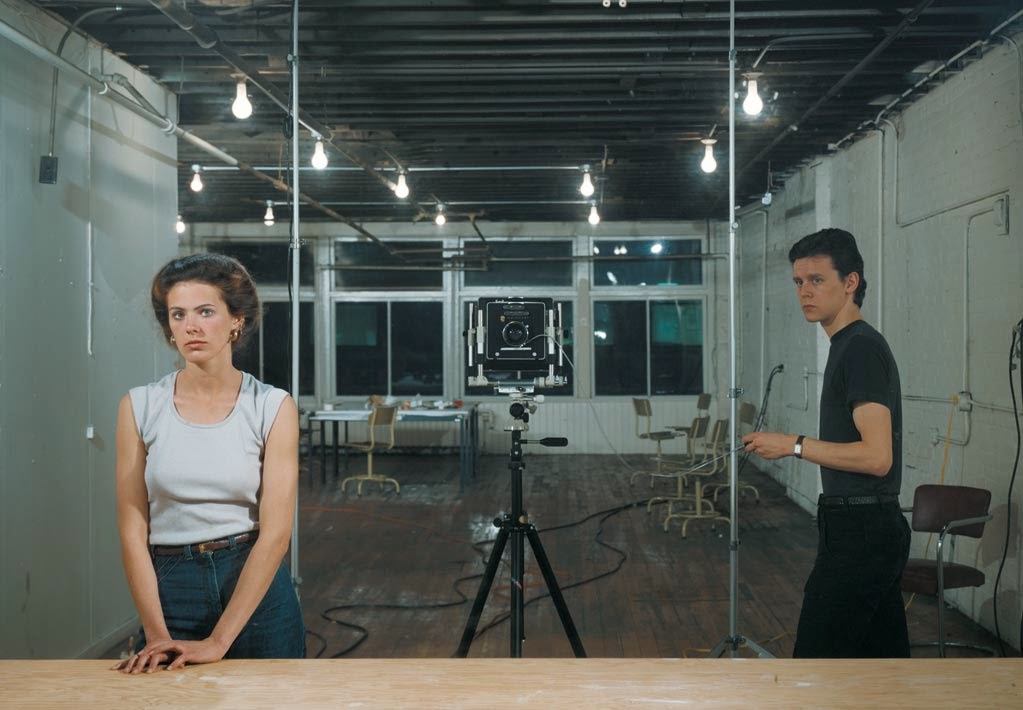
Frieda Khalo and Tina Modotti


I was surprised to find that under 'Realism' Wikipedia had nothing. To me, Realism was the very stance that guaranteed the relevance of photography.

Documentation, reportage are the very activities I grew up with, not only with HCB, or Magnum, I certainly grew up with Life, Paris Match, and the lesser illustrated magazines that catered about film stars. 

Images of the Vietnam War and McLaughlin also defined v. well my youth. But suddenly all this was gone, replaced by Postmodernism, a re-photography at best, where the very concept of tangible reality had become doubtful or even disappeared.

I found a useful British site that provides theses,  so let me quote it about Realism:

"Photography was now used extensively in art, and in the new postmodern culture. Postmodernism discarded the idea of finding something new and original and instead focussed on recombining elements from existing culture. Nothing new was being created which soon meant that art had become exhausted. The postmodern culture played ‘with signs of never ending reference, where the more you played the less anyone seemed to know what reality it was touching’ (Bate, 2004a: 31) and we had ‘lost touch with what we thought reality to be’ (Bate, 2004a: 31). The constant referencing and re-referencing had led to us being absorbed in representation. We no longer knew what reality was, and what it was not. We were lost. ‘The fear about postmodern culture was that there was no longer any anchor to reality at all, and that ‘reality’ had disappeared into an endless chain of other representations’ (Bate, 2004a: 31). 

"This never ending reference meant that all grip on reality had disappeared. There was a wish to return to something more stable and basic. There was a need for change, for something new to emerge from the endless trail of reference. In this culture, in which reality was discarded in favour of mass intertextual referencing, there was a desire to return to reality. As David Bate says, there was a, ‘wish for a grittier, ‘closer to reality’ relation through realism’ (Bate, 2004a: 35). Many people wanted a ‘return to the values of modernism (the straight and pure photograph) to contemporary art photography, this is a return to description, originality and actuality – precisely all the things that were strongly rejected by postmodernism’ (Bate, 2004a: 33).

I am not really presuming that with digital you can't do less or better than imitate film.You can with  Fuji's Film Simulation modes, or Olympus Art Filters. To me Kodak's Tri X. or Ektachrome are the very modes in which reality appears.

One knows wowever  perfectly well that in Digital Adobe reigns supreme, and with any of its sliders you can fetch any tone or colour your brain can conceive. So what is real?

There is also a social side of the question. As we saw in Rodchenko life in the streets, or in the city, squares,boulevards, was always meant as a presentation of the workers' life in the open, so it was the result of class struggle and social interaction. It is interesting to see that American humanist realism (The Family of Man) stepped back  from such a socialist endeavour.

For instnce Vivian Maier couldn't be packaged as a socialist photographer, but we can probably use classical photographers like Paul Strand and Tina Modotti, who were part of another interesting institution like the Photographers' League in New York. In the 1930s it put together all the progressive photographers of the era, without many of knowing that it was a Communist project.


March of the Mexican artists by Tina Modotti

Tina is interesting: the daughter of a communist artist in America, she was many things, a model, an actress,  a lover of Weston, a photographer, notably in Mexico, where she made friends with Frieda Kalho. She drifted towards social symbols (see her in the sombrero with sickle and hammer).


Campesina and self portrait, Tina Modotti

 After being expelled in Merxico, Germany and Switzerland she eventually fought in The Spanish Revolution with Moscow envoy Vidali. Although by 1940 she was herself a professional revolutionary, she gave up photography for more clandestine work.
Realism is certainly connected with social awareness in my conception, but not necessarily with communism. In the 1930s however the choice was stark between Nazifascism and communism, so one can't really use the same metrics of today. Just to remind of the times, Tina was actively researched by the Italian Political Police for assassination.

 It was while on a fieldtrip in this class that Strand first visited the 291 art gallery – operated by Stieglitz and Edward Steichen – where exhibitions of work by forward-thinking modernist photographers and painters would move Strand to take his photographic hobby more seriously. Stieglitz would later promote Strand's work in the 291 gallery itself, in his photography publication Camera Work, and in his artwork in the Hieninglatzing studio. Some of this early work, like the well-known "Wall Street," experimented with formal abstractions (influencing, among others, Edward Hopper and his idiosyncratic urban vision). Other of Strand's works reflect his interest in using the camera as a tool for social reform. He was one of the founders of the Photo League, an association of photographers who advocated using their art to promote social and political causes.
Mostly because of the same Internationalism, Paul Strand came to incorporate the same ideals: his portraits in Ghana a or Sardinia wouldn't show only portraits of the individual, but also the social relationships.


Paul Strand, Ghana


Paul Strand, Sardinia

In both social relationships jump to the eye. There is no beautification.

In June 1949, Strand left the United States to present Native Land at the Karlovy Vary International Film Festival in Czechoslovakia. The remaining 27 years of his life were spent in Orgeval, France where, despite never learning the language, he maintained an impressive creative life, assisted by his third wife, fellow photographer Hazel Kingsbury Strand.
Although Strand is best known for his early abstractions, his return to still photography in this later period produced some of his most significant work in the form of six book ‘portraits’ of place: Time in New England (1950), La France de Profil (1952), Un Paese (featuring photographs of Luzzara and the Po River Valley in Italy, 1955), Tir a'Mhurain / Outer Hebrides[2] (1962), Living Egypt (1969) and Ghana: an African portrait (1976).

portrait by Paul Strand

The timing of Strand’s departure to France is coincident with the first libel trial of his friend Alger Hiss, with whom he maintained a correspondence until his death. Although he was never officially a member of the Communist Party, many of Strand’s collaborators were either Party members (James Aldridge; Cesare Zavattini) or were prominent socialist writers and activists (Basil Davidson). Many of his friends were also Communists or were suspected of being so (MP DN Pritt; film director Joseph Losey; Scottish poet Hugh MacDiarmid; actor Alex McCrindle). Strand was also closely involved with Frontier Films, one of more than twenty organizations that were identified as "subversive" and "un-American" by the US Attorney General.
Strand also insisted that his books should be printed in Leipzig, East Germany, even if this meant that they were initially prohibited from the American market on account of their Communist provenance. De-classified intelligence files, obtained under the Freedom of Information Act and now lodged at the Center for Creative Photography at the University of Arizona, reveal that Strand’s movements around Europe were closely monitored by the security services.

All This took place under the auspices of the Photo League in New York (wikipedia):
The League’s origins traced back to a project of the Workers International Relief (WIR), which was a Communist association based in Berlin. In 1930 the WIR established the Worker’s Camera League in New York City, which soon came to be known as the Film and Photo League. The goals of the Film and Photo League were to “struggle against and expose reactionary film; to produce documentary films reflecting the lives and struggles of the American workers; and to spread and popularize the great artistic and revolutionary Soviet productions.”[1]
In 1934 the still photographers and the filmmakers in the League began having differences of opinion over social and production interests, and by 1936 they had formed separate groups. Paul Strand and Ralph Steiner established Frontier Films, to continue promoting the original goals, while at the same time Strand and Berenice Abbott renamed the original group to simply “The Photo League”. The two organizations remained friendly, with members from one group often participating in activities of the other. The goal of the newly reformed Photo League was to “put the camera back into the hands of honest photographers who ... use it to photograph America.”
The League quickly became active in the new field of socially conscious photography. Unlike other photography organizations, it did not espouse a particular visual style but instead focused on “integrating formal elements of design and visual aesthetics with the powerful and sympathetic evidence of the human condition.” It also offered basic and advanced classes in photography when there were few such courses in colleges or trade schools. A newsletter, called Photo Notes, was printed on a somewhat random schedule depending upon who was available to do the work and if they could afford the printing costs. More than anything else, though, the League was a gathering place for photographers to share and experience their common artistic and social interests
Among its members were co-founders Sol Libsohn and Sid Grossman (director of the Photo League School); Walter Rosenblum, editor of the Photo League Photo Notes; Eliot Elisofon, a LIFE photographer; Morris Engel (since 1936); Jerome Liebling, who joined in 1947; Aaron Siskind; Jack Manning, a member of the Harlem Document Group of the League and a New York Times photographer; Dan Weiner; Bill Witt; Martin Elkort; Lou Bernstein; Arthur Leipzig (since 1942); Sy Kattelson; Louis Stettner; Lester Talkington (from 1947); Lisette Model; and Ruth Orkin, a member from 1947.[4]
In the early 1940s the list of notable photographers who were active in the League or supported their activities also included Margaret Bourke-White, W. Eugene Smith, Helen Levitt, FSA photographer Arthur Rothstein, Beaumont Newhall, Nancy Newhall, Richard Avedon, Weegee, Robert Frank, Harold Feinstein, Ansel Adams, Edward Weston and Minor White. The League was the caretaker of the Lewis Hine Memorial Collection, which Hine's son had given the League in recognition of their role in fostering social activism through photography as his father had done.[
Most of the members who joined before the end of World War II were first-generation Americans who strongly believed in progressive political and social causes. Few were aware of the political origins of the movement of the communist "Workers as Photographers" (Arbeiterfotografen) in Berlin. This had in fact little to do with what the organization did as it evolved, but helped its downfall after the war, when it was accused by the FBI of being communist and "subversive and anti-American." In 1947 the League was formally declared subversive and placed on the U.S. Department of Justice blacklist by Attorney General Tom C. Clark. At first the League fought back and mounted an impressive This Is the Photo League exhibition in 1948, but after its member and long-time FBI informer Angela Calomiris had testified in May 1949 that the League was a front organization for the Communist Party, the Photo League was finished. Recruitment dried up and old members left, including one of its founders and former president, Paul Strand, as well as Louis Stettner. The League disbanded in 1951.By chance however I discovered that there was an exhibition at the Jewish Museum of New York, witnessing how much the European migrants had made for the city, between the two WWars.  Robert Frank was one of the most notable, although he would end persecuted himself:


by Robert Frank
Now can witness that in just one century the direction of photography changed completely: From social sensitivity to unbridled fantasy and reprophotography of Postmodernism. The question that matters, methinks, is if there is any advantage in going back to simpler times, where people mattered for what they did,  for the useful work they did, and not the money of the equipment they manipulated.

by Robert Frank

by Robert Frank
                                                      *

PS  check the Paul Strand exhibition just opening at Philadelphia, an anthology not to be missed:

http://www.theguardian.com/artanddesign/gallery/2014/oct/13/paul-strand-photography-masterworks-philadelphia-retrospective-in-pictures

Sunday, 20 July 2014

PostModernism: is Beauty in the eye of the beholder?

Shop window in blue, Rome, by me.


(Warning! Intellectual stuff. Stop immediatly reading if you don't trust Art, or demean intellectual endeavours.:)

In a debate on experiments in Photography, when I remarked that basically people are re-doing things that were already made, and that pictures need to be deconstructed, instead of using some bland Positivism, someone objected to me, that we are in post-positivism, that reality can be 'triangulated' from different Positive worldviews. So yes, but what about using some more serious tools, and not triangulate ignorance?

If one keeps in mind David Bate cronology of photography in Globalization

1870-1910  Pictorialism
1920-1930s Avant-Garde/Modernism (Formalism)
1945-1960 s: New Realism/Humanist Photography
1960-1979: Minimalism, Conceptualism/late Modernism
1980-1990s: Postmodernism/Neoconceptualism

One will indeed see that Photography was born in that era were the belief in Progress was indeed absolute, what we call Positivism, and that is indeed still the main implicit belief of DPR American readers, perhaps because they never experimented wars on their own soil. 

In Europe because of the two WW very little of that optimism remained after the Second WW. But even before that any trace of Positivism had been destroyed by the Irrationalism that fed  fascist movements, but also by Psychanalis, Marxism, and Surrealism in the Arts. Critique of Society and its myths had therefore become paramount.

After the 2WW an ethnologist with a long field experience, French Claude Levi-Strauss, proposed that despite all the differences there were some invariants in all human societies, including the primitive ones. and that was called Structuralism. It replaced Positivism very well in Academia, until a new generation of French thinkers began to show that the latter couldn't account for the hidden repressive instances of modern society, so that  European i.e. French poststructuralism began to destroy the idea of a shared reality from the 1970s.

I am naming Guy Debord and his 'The Society of Spectacle', Deleuze and Guattari, 'The Anti-Oedipus',  Jacques Foucault, 'Surveiller et Punir,' Julie Kristeva's semeiotics and Lacan's Psychanalisis. Without forgetting 'Mythologies' of Barthes, who would later carry his deconstruction to Photography.

The Society of Spectacle book, courtesy JulieAnnAshcraft, flickr

 In a decade they dissolved all idea of a positive reality, Photography and the arts could lean on. Nothing was known of all this across the Pond, however, if one excepts Susan Sontag's 'On Photography', a first attempt to deconstruct the myths behind mass photography.

The Theory of the Fetish, the totalitarian Golden Veal of the merchandise, the central concept in Consumerist Societies, was posited  by Jean  Baudrillard at Montreal University in a number of essays on Cinema and the Visual Arts, and from there it spawned to the best East Coast universities. 
Such central concepts like Deconstruction and Narrative have entered day to day language from there. Semeiotics is still an empty word for most, but that's what we use as a method to disentangle Visual Meaning. Have a try here:

Yes but what about Photography? you will ask. As I showed Conceptual Art,  Art as Idea, removed any relation to a positive reality. Art self-referentiality however could not bear the weight of Globalization. Too many worldviews were clashing all of a sudden.
That was what David Bate meant by Post-Cinceptualism?
That was the difficulty I faced, how to illustrate this plurality, until I found this: Arthistoryunstuffed

 Jeanne Willette

This is a wonderful essay by Dr. Jeanne S. M. Willette of the Orange County Museum of Art, California, from which I will largely draw  the next paragraphs. This will help me facing my largest midbrow audience, the American one, with no need of further 'exotic' arguments.


This is what you find when you dial in Google 'Postmodern Photography' Quite a jumble! Just try: it changes all the time!

"Photography became the postmodern art form par excellence, taking the place of painting when the Modernist precepts of European art became exhausted by the 1960s.  Unlike painting, photography did not have to grapple with, and overcome a high art past, nor was it touched by high art theories. Because  photography was, as Pierre Bourdieu would say, The Middle Brow Art, it was ideally suited for Postmodernism to occupy the practice. Even in its virginal state, photography was also impacted by the fact of the “Image World.” As Guy Debord explained it in The Society of the Spectacle,the world had become a “spectacle.”

In societies dominated by modern conditions of production, life is presented as an immense accumulation of spectacles. Everything that was directly lived has receded into a representation… The spectacle is not a collection of images; it is a social relation between people that is mediated by images. The spectacle cannot be understood as a mere visual excess produced by mass-media technologies. It is a worldview that has actually been materialized, a view of a world that has become objective. "

Andy Warhol image: Campbell's can

"Therefore, contemporary visual culture was, by definition, a spectacle disseminated though photographic forms, reproductions of reproductions, simulacra of a reality that never existed. Through photography, visual culture had become part of the spectacle of popular culture that fascinated its audience and hypnotized them from critiquing society and created a certain kind of social relation. As Debord said, “In a world that is really upside down, the true is a moment of the false.” When Debord’s influential book was published in France in 1967, the vernacular photography of Robert Frank, Diane Arbus, Garry Winogrand, and Lee Friedlander had exhausted itself. The innocence that had allowed photographer or the audience to assume that direct photography was a reliable form of “truth” was crumbling on the disillusionment of the Viet Nam War."

Warhol image: 2nd Campbell's can

"In an Image World overflowing with images and stuffed with history, it is impossible to “take” pictures with a fresh and innocent eye: all pictures are seen only through other pictures–pictorial intertextuality. Photography is no longer about capturing realism, as it was in the days of Robert Frank and his followers, but was concerned with re-creating images of images.  Without the possibility of reality, postmodern photographers are not photographers in the historical sense and they cannot photograph objects in the traditional sense.  They can only fabricate simulacra or record the hyperreal of the Postmodern world.  It would be correct to question the term “photography” in the context of Postmodernism.  “Photography,” as a direct and immediate capturing of reality takes a certain amount of naïvité, no longer available in the Postmodern era.  All photography has already been done.  The term “re-photography” would be more precise to describe Postmodern photography."

As a visual example of what a PostModern photog. can do nowadays let me recall a picture by David LaChapelle, for didactic purposes.


Again dial his name in Google Images and see what comes up,. It's quite breath taking, One seems to be carried in the World of Oz. Fantasy with no relation to reality whatsoever. From Warhol's Pop Art, to hyperrealism, and then Dreamland, or Pseudorealism with LaChapelle.

But it's no surprise, such has always been the realm of Commercial Photography and Adverisment for years: simulacra with no reality, i.e. the Fetish. Notice that some even wink to sadomasochism. But it's of the babydoll kind.

It's nice seeing an American like Dr. Willette's getting into the European frame of mind of critical thinking. Sexuality and social awareness having for so long being banned from the American scene, the positivist worldview is just another version of bourgeois quiet living and idealism. LaChapelle mocks it, but without really debunking it

Long before this standstill,  in 1971, with her book 'On Photography',  Susan Sontag had attempted something similar to deconstruction of the Fetish. I quote from THEME, which recently dedicated a post to her.

"Sontag calls the photographic image a control mechanism we exert upon the world — upon our experience of it and upon others’ perception of our experience. What makes this insight particularly prescient is that Sontag arrived at it more than three decades before the age of the social media photostream — the ultimate attempt to control, frame and package our lives — our idealized lives — for presentation to others, and even to ourselves. The aggression Sontag sees in this purposeful manipulation of reality through the idealized photographic image applies even more poignantly to the aggressive self-framing we practice as we portray ourselves pictorially on Facebook, Instagram and the like:

"Images which idealize (like most fashion and animal photography) are no less aggressive than work which makes a virtue of plainness (like class pictures, still lifes of the bleaker sort and mug shots). There is an aggression implicit in every use of the camera."

Thirty-some years after Sontag’s observation, this aggression precipitates a kind of social media violence of self-assertion — a forcible framing of our identity for presentation, for idealization, for currency in an economy of envy. She goes even further in asserting photography’s inherent violence:

"Like a car, a camera is sold as a predatory weapon — one that’s as automated as possible, ready to spring. Popular taste expects an easy, an invisible technology. Manufacturers reassure their customers that taking pictures demands no skill or expert knowledge, that the machine is all-knowing and responds to the slightest pressure of the will. It’s as simple as turning the ignition key or pulling the trigger. Like guns and cars, cameras are fantasy machines whose use is addictive."

Susan Sontag

 If you look at DPR gear debates, and the weak tentatives to make a more general discourse on Photography, you'll see how Middle America is still  fully immersed  in the consumerist fetish of the omnipotent camera.

To recap, the pioneering work of the French in semeiotics allowed to deconstruct the myths of popular culture. Some 30 years later  the Theory of the Fetish and its uses spread to American Academia and Photographers.
Remember when I said 'no image is innocent?'

As  Dr. Willette writes:

"By the 1970s, photographers were beginning to explore three issues in the discipline. First, “straight photography” and its corollary documentary photography were played out. Second, the “truth” value of photography had been undermined and the role the medium was playing in constructing a particular kind of society—of spectacle and of complacent citizens—was becoming clear. Third, it “straight photography” could be manipulative of society then it would seem that it was once again permissible to manipulate photography. Postmodern photographers would confront these particular conditions during the eighties in a knowing and often highly theoretical fashion."

Cindy Sherman's a Film Still - Final Moma (for didactic use only)

"Postmodernism is characterized by self-conscious and deliberate intertextuality. One of the best-known photographers who played with simulacra is Cindy Sherman.  Sherman should be termed a performance artist who restages images from mass media.  Concentrating on how women were represented by movies, she had herself photographed in a series of small black and white photographs called “Film Stills” during the late 1970s.  None of these theatrical re-presentations can be traced back to any actual movie but all remind the viewer of movies they have seen or have heard of and evoke the construction of women in the 1940s and 1950s.  

"Sherman is what can be called a “post-feminist,” or an artist who takes up feminist concerns, not from a political and activist perspective but from a theoretical stance.  Because society manipulates the social being who is proved to be infinitely malleable, Postmodernism no longer believes in the Modernist possibility of evolution towards a goal. There is only arbitrary change, determined by the dominant class for its own purposes.

 C. Sherman, step

Willette: "All Postmodern theory can do is to point out that gender is constructed  by the culture and by mass media.  Unlike early feminism of the 1970s, post-feminism is not essentialist but is constructivist, maintaining that there is no such thing as a “women” only an image that is created by ideology and is named “woman” by the culture.  Sherman’s Film Stills are pure simulacra: there is no “woman,” there is only the image of woman.   A film is an image of an image of a woman.   A film still is an image of a woman of an image of a woman of an image of a woman.  Simulacra is a “third order” of “reality,” meaning that a simulacra is three moves away from a reality that never existed in the first place. Because Sherman performs a variety of female roles, playing the woman for a male audience, she should be considered a performance artist who photographs her work, rather than as a traditional photographer."

BTW the same deconstruction  has been applied by Dr. Eva Rus to Francesca Woodman's work. She was probably going to move  from Surrealism to Postmodern, and it's a pity that she put an end to her artist's life so early. Note how important was Photography  for the Female Liberation movement. Suddenly there were a lot of women photographers who were playing with their identity on stage.


There is another interesting author to explore as a 're-photographer': Jeff Wall. I am quoting again Dr. Willette, since I couldn't have done better.

"Sherman was not the only photographer to stress the importance of performance and artifice in Modernism, present in Western art since Édouard Manet.  Like Sherman, Jeff Wall uses intertextuality by reenacting significant “major monuments” of Modernist art through the Postmodern art of manipulated photography.  One of the early users of computer manipulation, Wall, like Sherman, is less a “photographer” in the classical sense, and actually works in the “directorial mode...” 
"Because he is referring to invented works of art, in addition to staging and directing, Wall must manipulate photography.  In A Sudden Gust of Wind, Wall uses the computer to throw white sheets of paper into the stiff breeze, combining postmodern technology with the past. Like most Postmodern artists, Postmodern photographers re-explore the past and revisit history."

Sudden Gust of Wind (Quoted for didactic purposes) 


The original Hokusai picture, Brooklyn Museum.
Wikipedia: "Based on Yejiri Station, Province of Suruga (ca. 1832) a woodprint by Katsushika Hokusai, A Sudden Gust of Wind recreates the depicted 19th-century Japanese scene in contemporary British Columbia, utilizing actors and took over a year to produce 100 photographs in order "to achieve a seamless montage that gives the illusion of capturing a real moment in time".

Pictures of women, by Jeff Wall
This is an optical illusion whereby the photographer trades her place with you. It is a re-photography of a camera setting.

Another interesting Postmodern photog to consider is Andreas Gurtsky. In fact we already analysed one of his extraordinary pictures.

Gurtsky's Engadine picture, with the line of skiers betraying the sanctity of the perennial snow.

Engadine. 
Gursky is also the author the most expensive photo ever sold at an auction, $ 4.3 Million, which has a mesmerizing effect, suspended as it is between the flat plane and the depth. Call it romantic! 
"Justifying this manipulation of the image, Gursky said :"Paradoxically, this view of the Rhine cannot be obtained in situ, a fictitious construction was required to provide an accurate image of a modern river."(Wikipedia)

Here it is:

Rhein II Pic (only for didactic purposes)  $ 4.3 Million!

However good and even perfectionist they are, these photogs. can't hide the fact that what they are really doing are pictures of pictures, in the second or even third degree. Possibly any passers by were cloned out of the piccie.

So where are we now? In 'Globalization' I already mentioned  that the Winterthur's Fotomuseum is currently holding a debate, where some argue that Photography is finished, because curators can't fix any criteria f for selecting Photo Artworks anymore, since anything goes. It is the End of Photography as a social endeavour in other words. 

Others have advised a return to realist, or neo-realist photography a' la Paul Strand, like Barcelona artist Jorge Ribalta:

Paul Strand's Ghana portraits. Chief and Elders

In Portraits of Modernity.

I would rather agree and that is what I try to do, by shooting simple and trying to socialize with all walks of life, with the aim of showing common circumstances. But as I mentioned in my post about Wearable Glass and 360°  I am afraid I am too late: a new technology is upon us which will sweep us into a kind of real/artificial augmented reality uneheard of before.
Perhaps we should accept the disappearance of the camera, and welcome a new degree of pictographic experience?

In fact, as Alan Kirby, Chair of Literature from Exeter Uni, UK writes we have probably entered a new phase one could call Pseudo Modernism. Beware, there is scathing in his words:

"whereas postmodernism favoured the ironic, the knowing and the playful, with their allusions to knowledge, history and ambivalence, pseudo-modernism’s typical intellectual states are ignorance, fanaticism and anxiety: Bush, Blair, Bin Laden, Le Pen and their like on one side, and the more numerous but less powerful masses on the other. Pseudo-modernism belongs to a world pervaded by the encounter between a religiously fanatical segment of the United States, a largely secular but definitionally hyper-religious Israel, and a fanatical sub-section of Muslims scattered across the planet: pseudo-modernism was not born on 11 September 2001, but postmodernism was interred in its rubble. In this context pseudo-modernism lashes fantastically sophisticated technology to the pursuit of medieval barbarism – as in the uploading of videos of beheadings onto the internet, or the use of mobile phones to film torture in prisons. Beyond this, the destiny of everyone else is to suffer the anxiety of getting hit in the cross-fire. But this fatalistic anxiety extends far beyond geopolitics, into every aspect of contemporary life; from a general fear of social breakdown and identity loss, to a deep unease about diet and health; from anguish about the destructiveness of climate change, to the effects of a new personal ineptitude and helplessness, which yield TV programmes about how to clean your house, bring up your children or remain solvent. This technologised cluelessness is utterly contemporary: the pseudo-modernist communicates constantly with the other side of the planet, yet needs to be told to eat vegetables to be healthy, a fact self-evident in the Bronze Age. He or she can direct the course of national television programmes, but does not know how to make him or herself something to eat – a characteristic fusion of the childish and the advanced, the powerful and the helpless. For varying reasons, these are people incapable of the “disbelief of Grand Narratives” which Lyotard argued typified postmodernists."

Sorry for the long text and quotations, I can strike a deal with you and promise that from now on, there won't be anymore chronologies and Art movements  involved, but only single excellent photographers brought up.

In my search for a solution of the actual catch 22 in Photography, between fake reality and unbridled fantasy,  I am considering to go back to socially concerned photographers like Paul Strand and Tina Modotti, and watch what they brought to their honest and simple table :)

No it's simply not true that anything goes, otherwise we would end up with pretentious postprocessing like this  "Ph-art" poster at DPR.

By using painterly plugins they were proud to obtain impressionist women that were done by French painters one century ago. Is this progress, mere defacing and smearing of an image, like adding too much lipstick?
David LaChapelle, Amanda as Marylin

Or take the photoshopped, beautified images of Marriage hacks that seem to have become the standard for so many camera owners.All their suburb life will be beautified, including their visits to Disneyland. And if you criticize, you ll' be called an old fart, with pretentions to something they don't care a fig about.

OverPP plus lack of visual culture have perverted the course of Photography, and created true monsters, and general mediocrity. So beauty is NOT in the eye of the beholder,  I would propose, instead it is the result of restraint, work and good intuition.

Art is very similar to Science. If you want to publish a new theory it must be Relevant to some aspect of the Physical World, and it must be Elegant, i.e. it must not waste means to get to its end. Nobody would publish sloppy Science, or a uselessly complicated theory. 

Nobody would publish some Art just because it has been made with the best camera in the World, or overprocessed with the latest software, as the majority of people believe in forums.

Instead Artists will always  do better with small but adequate means, if they have integrity, and some clear cut concepts about their work. Then it's a matter of testing these new concepts to the very end. It took Wall one year of work with actors and computers to arrive at the Gust of Wind picture! With Art you are at the forefont of the evolution of human thinking. Need any proof?

'Nihil fuit in intellectu quod non fuerit in sensu', said philosophers, from Aristotle to Berkeley.
In Art you start with the senses, but the end product is in the intellect. Photography is an intellectual endeavour, no matter how desultorily simple it appears. It is the most democratic of the arts, but this implies an even greater need for clarity, honesty and the elimination of dead ends.  Although one might be happy with the Likes and Favourites of one's Social sites, there is always a more direct, unexpected way to tap the underlying reality.

And suddenly, as a relief to these questions without answer,  it came to me out of nothing, from a sleepless summer night: just two words 'Bright Star', I was puzzled, then I remembered  it was Keats:

Bright star, would I were stedfast as thou art—
         Not in lone splendour hung aloft the night
And watching, with eternal lids apart,
         Like nature's patient, sleepless Eremite,
The moving waters at their priestlike task
         Of pure ablution round earth's human shores,
Or gazing on the new soft-fallen mask
         Of snow upon the mountains and the moors—
No—yet still stedfast, still unchangeable,
         Pillow'd upon my fair love's ripening breast,
To feel for ever its soft fall and swell,
         Awake for ever in a sweet unrest,
Still, still to hear her tender-taken breath,
And so live ever—or else swoon to death.

Appreciate the economy of means,  the  equivalence between the Star and the Beloved. It is a perfect picture, conjured from imagination. Like a perfect shot, if you wish. Likewise, there must still  be room for intuition and poetry in Photo, beyond the artifices!