Showing posts with label Sublime. Show all posts

Saturday, 31 May 2014

A docudrama about the short life of the photographer Francesca Woodman

This is an interesting docudrama without a title put on air at Artè TV in 2007, and directed by Jérome de Missolz,  true to Francesca's biography. It shows  well how she shot some of her best pictures. The French actress looks very similar  to Woodman, although she is a brunette, and speaks French in the film. Perhaps you can use a Skype live translator, when it comes, end of 2014

There are some factual inaccuracies, since she is using an old Exacta 6 x 6, instead of the Speed Graphic, or the Rolleiflex, she was known to use.

It is not v. probable either that she went to bed with her Italian dealer , who is here represented as an old man, while he was almost the same age of her, and provided with a jealous fiancée :)

The lesbian scene I don't know about it either, and the locations are rather abstract. Why make her a sexual maniac?  Perhaps we might make one day a better follow-up, by looking in her motivations as an artist.

The docudrama was ordered and broadcast a long time ago by a public TV, so I am told that  there is no harm in downloading it for private use. It lasts 70 minutes, and is some 250 MB, in the Mpeg4 format (Quicktime).

Be aware that when you click on the link,  the download page might be below a pop up Ads page, or in the page before that:

Or you can try a direct download here: 360p

Enjoy the movie!

The opening quotation reads: 'Je est un autre' - Rimbaud. 'I is Another'


Note

Despite  the interesting placements of the actress in front of the camera, I think that finding visual metaphors and making them into emblems,  is still a matter of hard thinking - like creating a crossword, if you wish.

I am told that the young actress was a beginner model, who enjoyed to stay on the other side of the camera. Francesca, liked both sides, but had to toil in order to achieve the right composition, since there was nobody in front of her.


And now an original F. Woodman's contact shot to compare :)


Monday, 5 May 2014

Francesca Woodman, on being an Angel


In forums, when not classified by camera model, users are presented with genres, like Landscape, Portrait, etc. That is how camera users see Photography, with documentation as the general category. We are just recording things for future memory.

Of course there is also a third way, to see it historically: Naturalism, Realism, Avant-Garde, Conceptual, Globalization. You might refine it, or adopt another sequence. Surrealism sprang out of the Avant-Garde beginning of the 1920s in Paris and had a remarkable long life, moving to America and New York in 1940 and lasting till the 1970s, with F. Woodman as one of its last heralds. 

Meanwhile Photography  had entered the MOMA in NY and had become an art.
When I began to approach critically Woodman's work, I was struck by the lack of awareness shown by the first reviews. Essentially she was dubbed a feminist, or at best a body artist, who had died in turbulent times. They had missed her seminal Italian year, when she bloomed from art pupil to full blown artist. The fact that she reached her accomplishment here in Rome at 18een, while dying at 21 in NY didn't make things easier.


It was only years later that criticism began a more refined approach. Meanwhile she had reached somehow cult status, both in the US and Italy, being dubbed the 'Rimbaud' of Photography. This put her indirectly in the Surrealist sphere, Rimbaud having been among the main inspirers of Breton and comrades. Woodman has stated explicitly her admiration of Breton's 'Nadja'.

Woodman is reported as saying "Vorrei che le parole avessero con le mie immagini lo stesso rapporto che le fotografie hanno con il testo in Nadja di André Breton" ("I would like words to have the same relationship with my images as the photographs have with the text in Nadja by André Breton").

 But among her influences there was also surrealist photogs. Duane Michals, Diane Tuberville, and the Man Ray of the Meret Oppenheim's pictures. Delving even earlier she was inspired by Gothic Fiction, Roman Baroque and Bernini's statues. Some of her studies on compressed perspective remind very much of Giotto. She might have seem him during her yearly holidays as a child near Florence. Giotto invented perspective, what luck for a future photographer to get it from the horse's mouth.

Francesca began her activity v. early at 13, spending  her time at the Rhode Island School of Design (RISD). She was also immersed in Italian art every summer by her parents, both artists, and she spent her second year of primary school in Italy, until she reached Rome with her RISD grant for 1977-78.

It's at the Libreria Maldoror, a minuscule Surrealist bookshop in the heart of Medieval Rome, where she had her first show, that I must have crossed her. Nearby the wonderful Baroque Piazza Navona   you could both find Maldoror, the occupied building of the 'femministe' (Women Liberation Front) , and the second hand shops where she chose her neorealist clothes. I remember that the slogan with those ladies was: 'Il corpo e' mio e me lo gestisco io'- the body is mine and I will Take care of it". A program that Francesca was going to adopt entirely, by being her favorite model.


She was also inspired by the Italian conceptual artists at Galleria Ferranti,  nearby Maldoror, and later Postavantgarde painters who let her use one of the large rooms in an abandoned Factory. Thus, she got in touch with Sabina Mirri (painter), Edith Schloss (poet), Giuseppe Gallo (painter) , Enrico Luzzi and Suzanne Santoro. I was acquainted with the first three, all remarkable young artists at the time.

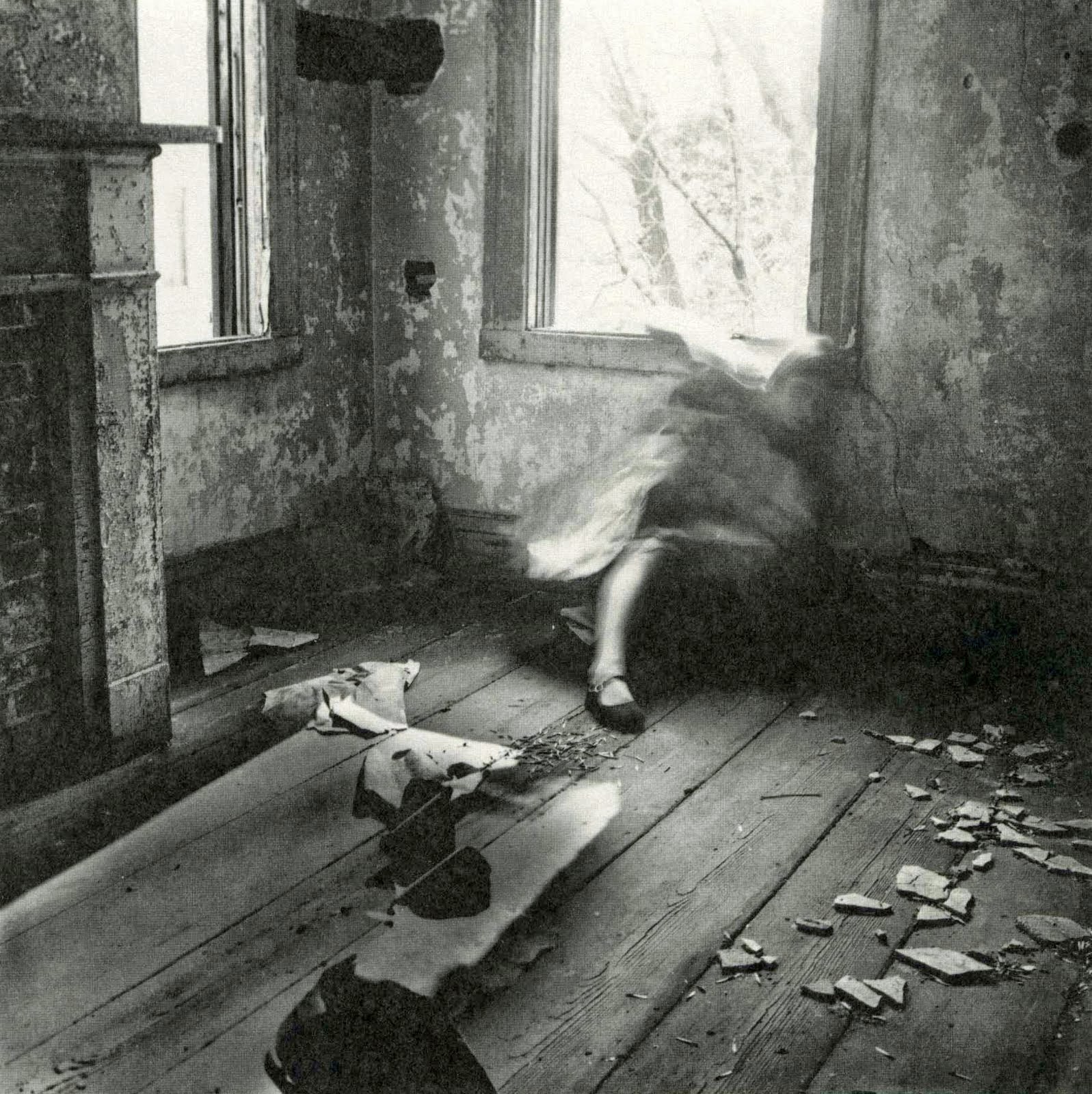
 In the factory at S. Lorenzo she shot  her seminal 'On being an Angel' work in Rome, when just 18. A whole constellation of influences was in place, but nevertheless her work was far more original than her critics initially made it after her death in 1981, when she wasn't there anymore to correct their hits and misses about her. She could be a cultured artist and yet deceptively simple too, playing a Victorian innocent maid, a clever child the way Charles Liddel's Alice was. 

The only Art Book  she made in her short life was 'Some Disordered Interior Geometries' appeared in 1981, a few days before her death. Her parents have given access to only 700 pictures, all outstanding but her estimated production from 13 to 22 has been estimated to 10,000.  Even given for granted that a photographer must always select his/her work, we know therefore a v. little part of her work. Her work is kept by the Woodman Estate. Some 170 are being sold through galleries. The known production therefore poses a problem.

The majority of her pictures are from contact sheets of 6x6 cameras, notably an old Speed Graphic, and a Rolleiflex. The SG allows multiple formats too.

The contact shots being v. small and square confer both intimacy and a confined  space to the subject - only in her later years she planned an installation of large photographs, an installation simulating the friezes of a Greek Temple).
I related in a first post how I was sent an illustrated invitation, by her. I could make out a square with a naked body exposed to the full sunshine  from a factory window. And this reminded me later of Bernini, The Ecstasy of Santa Teresa, in Rome. Did she see it, or was it a personal rediscovery of how to tell pictorially a female orgasm?


An invitation sent to me: therefore I feel authorised to use images here for learning purposes.

Religious and sexual drives have one and the same origin  according to Bataille and other French Surrealists working towards Convulsive Beauty and a new History of Eroticism. Thus there is a common iconography across cultures. There are also common interdicts.

Without stating it so explicitly Freud posited it with its fundamental enquiry on dreams and the incest complex, when the child goes through a mirror experience because of the denial of his sexual drive, towards the mother or the  father. His Ego doubles and splits, in order  to avoid what Lacan will call 'The Thing' - the forbidden one.

The theme of mirrors and splitting is omnipresent in Francesca.
Hysteria was also part of the constellation, and was the main study at the Salpétrière hospital where Breton had been a nurse: were transe, orgasm, and religious ecstasy one and the same thing? Breton took an interest, because he believed that the sublimation of the sexual drive would have made art revolutionary: 'la Beaute' sera convulsive ou ne sera pas'.

By visiting each Summer Florence and her public Renaissance Gallerie, Uffizi and Pitti, Francesca must have been well aware that an excess of light was akin to the visitation of an Angel, and the total awareness of the artist, visited by inspiration. Nakedness in the Renaissance was also a metaphor of truth.

As Dr. Eva Rus remarks in her paper, the theme of the mirror is indeed omnipresent both in the work of F Woodman and other Female Liberation's authors. It is a theme that both frees the body and protects it with mirrored, multiple identities. It can also encage however.

In Feminist parlance, by exposing her naked body to a mirror, she re-appropriates it. She echoes male desire, but she also detaches herself from it.
Both David Bate and Eva Rus have discussed the implications of this important theme. It is a counter to the paradox that Breton and he early  Surrealists  had come against with their theories about Woman and sexuality, both a Goddess and a public woman, with Sadism and Courteous Love taken in the same stride.
Rus mentions that by her work,  Francesca was speaking for women, not just for a woman, playing with male desire, but not ending in it, exploring instead womens' sexuality, and identity down to the unspeakable, and the excessive (Rus). 


One's own shadow, duplication, wish to disappear, and condensation of dream figures are all part of the Surrealist imaginary, suggested by Freud. You can all find them in Francesca's figures. She played with the whole range of the Freudian symptoms to reenact myths. So we go from the passive interpretation of the unconscious drive by the early surrealists a' la Nadja, to active impersonation of dream figures by Francesca - the mark of genius! 
In some pictures one wonders if turning rapidly about herself she didn't achieve a trance like a dervish, and disappearance into space - blending the frame and the object in another dimension.

Despite the excess, let me remind that Francesca has aptly described her work as solving visual ideas as if they were equations 

 "I had this idea to illustrate physically literary metaphors  and to make physical metaphors for moral ideas (the reputation). However by working slowly at other projects, I lost the peculiarity of this idea and I came out with a group of images that didn't illustrate any specific concept, but are the story of someone who is exploring an idea […] Let's  follow a figure who tries to solve the idea as if it were a mathematic problem, and to fit it inside an equation. Two months later […] I was back to the original theory for illustrating 'Self-deceit' […] the thing that I found most interesting was the feeling that the figure, more than hiding from itself, was absorbed by a thick and humid atmosphere".

Do you understand the description? Visual artists are often deceptively simple, but they cannot explain what they choose to illustrate in another way.  This is how I basically see her work, since at the time I was a performer myself. First you empty the scene, the physical space around you and in your mind. Then you begin testing visual hypotheses in this virtual space. You use chance associations, even dreams  to suggest the solution, how things must fit spatially.
In Self-Deceit the object of the camera, the model, literally navigates between two mirrors, the second being the camera, and in  this virtual space it becomes again a subject - with multiple directions and identities it can choose from.

The camera however is not only a mirror but a a perspective machine.  For Francesca thus the problem, as for every photog, must have been to fit a 3D space in the bidimensional plane, and in her medium format a  6x6 square at that. 
In some shots her caged body  acts to as the bridge between the illusory three dimensions of the perspective and the plane of the photo. Often the frame beheads her, as in the first picture, and here:


It immediately reminded me of the problem faced by Francis Bacon, when fitting a soft blob of a body, a monster inside a perspective cube, drawn with sharp lines, cutting as blades.

Francesca could do the same by fitting a mirror at the end of the frame and by moving rapidly in front of the objective with slow shutter speeds.  "Me and Francis Bacon and all those Baroques are all concerned with making something soft wiggle and snake around a hard architectural outline." So I wasn't wrong after all.


Again, did she use the rapid movement just to disappear, or to achieve some sort of transference through the looking glass, like Alice?

Let me end here with one of her most interesting pictures, where she transforms herself like Daphne  into  a tree, in a pond in Providence, USA. You can easily compare it to Bernini's work, which Francesca must have seen while in Rome.


In symbolic terms the scene is interpreted as the nymph transforming herself into a tree, to flee a rape by Apollo. It might also be interpreted as another metaphor of desire imagined by Bernini, where woman becomes again unconstricted nature, to escape male desire. Is that what Francesca had in mind with her Providence surprising picture? Or did she want to be"absorbed by a thick and humid atmosphere" and disappear in a protective womb?

Besides the psychological interpretation, as photogs. we might wonder how Woodman solved the technical problems. Where did she place her Speedgraphic, in the water, on a tripod? Did she frame exactly the roots under which she would then have placed her naked body like Daphne? Did she use flash lights? What a fascinating way to work, for a girl who was just 18, and yet already so mature.

So we know a few things now about Francesca's very original  approach to photo work, but in the next instalment I would like to explore better her symbolic world with Dr. Eva Rus from the U. of Birmingham. I found it to be a most fitting paper about Woodman,  after I read so many mundane comments that missed the artist, and only described the woman.

Francesca went so deep in her photographic performances and metaphors that it is difficult to imagine anyone as her successor - although she has many imitators.  Perhaps that explains too her cryptic statement before she took her life. She was really an angel who departed before people took notice of her, except a few fellow-artists.

"I have parameters and my life at this point is similar to the sediments of an old cup of coffee, and I would rather die young, preserving what has been done, instead of confusedly rubbing out all these delicate things,

She threw herself from a skyscraper in NY,  after a long depression, insufficiently cured by analysis, allegedly because of a grant application having been rejected.  

Others mentioned she had wanted to become a Fashion Photographer, like her admired Tuberville. Perhaps Vogue rejected her? -  an issue complicated by problems with her boyfriend.

My next enquiry would rather be if in her 'descente aux enfers', descent into hell, she had not rather reached something monstrous, a figure of the unconscious which was unbearable, like those wrathful deities that Tibetan Buddhism tries to exorcise and exalt at the same time. This was the monster in 'Yet another leaden sky':


  Francesca could use elegant metaphors, like the momentous arrival of a turtle in a room. Her double hides from it, and  is literally cornered by the monster in a shortened perspective, and as a result it loses its face. It wears the black veils of melancoly. It is an emblem that needs to be decoded, and yet keeps a high degree of ambiguity.

Notes:

1. I have avoided nudity, which is difficult with F. Woodman, to respect the guidelines set by my tentative sponsors, Amazon and Google. On another plane, belonging to the same generation of Francesca, we can both have a (sad) laugh at it. By a paradox you can see all the pictures of her lovely body, by doing a Google search :)

2. I propose you to solve an enigma. Because of her short life, and because she worked with film (120 format mostly) I cannot be sure if we see now her actual prints, or negatives that were printed by the Woodman Estate. This would also tell us how much she postprocessed in a film darkroom.
My impression is that she did just contact sheets, and solved all the problems before pushing the shutter button. That is, she used slow shutter and double exposure to achieve her disappearing acts. The S. Lorenzo lofts with big industrial windows would have offered all the natural light she needed.
Keep in mind that I have somewhat enlarged the original 6x6 size to better analyze the details. In the 'Daphne' shot, the contour  of the tree seems to have been relighted, since it has a kind of otherwordly glow. Relighting however was standard processing in film times.

3. The bare facts of her life by Wikipedia

Sunday, 20 April 2014

'Nadja', a follow up.

* Warning: Intellectual stuff! jump altogether if you are not into psychology and deconstruction.

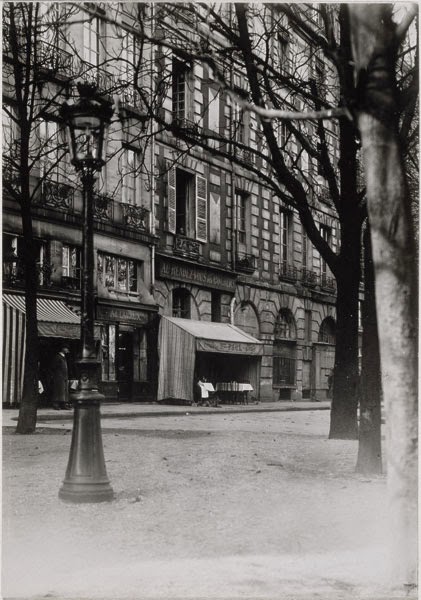
My friend Daniel Jouanisson, videographer, sent me this photo update on the squares of Paris in 'Nadja'. Judge yourself how little they have changed in almost one century!

Hotel des Grands Hommes
How important were those squares for the  the story of Nadja? Here is another interpretation by Critic David Bate, from Westminster University in 'Photography and Surrealism' .

Deconstruction technique is interesting here because it allows to get to the bottom of the most indifferent image, and extract its true meanings. Remember: no photograph is innocent!

You can always connect it to a context, to a choice and a photographer's point of view. Here we are told about Nadja's madness, so pychanalysis is suitable, and it might even explain the hidden meaning of those sad squares that populate the book.

In his book, Bate relates Surrealism and Sexuality, giving an explanation to the Enigmatic.

Some images draw us, even if we don't know why. Interpretation can provide the explanation. Finding the culprit is like finding a serial killer by Forensic Science. 
Out of necessity the language is specialized. My comments will try to clarify.

David Bate: "The photographs in 'Nadja' echo this structure of loss through their emptiness. As the reader views the photographs in relation to the text, the pictures are dis turbingly empty, 'lacking' in actual events. Looking into these photographic spaces where any decisive momenthas 'disappeared', we wonder what is the other there. 
Just as Nadja loses her image of identification, so the 
reader of Nadja is deprived of a reflected identification 
in the photographs. Most of the photographs, even the 
portraits, have a mute and mournful look, there is a 
'dinginess' in these pictures, rarely noted by commenta- 
tors as such, through which their 'mood' of emptiness 
invades the book. 
Expecting to find photographs of the events in their captions, the reader finds them lacking and it is in this way that an enigma emerges".

In the book the onset of the Enigma is also marked by the impromptu appearance of a fortune teller:


When Nadja told Breton she saw herself as Helene, Breton was reminded that a clairvoyant had predicted days before their meeting that he would get involved with a Helene. Another unlikely coincidence!
Breton and Nadja are approaching the Unconscious zone, which is timeless. They can meet, but they can also differ, having different unconscious goals.

David Bate: "Towards the end of Nadja, Breton says that he wanted some of the photographic images of the places and people to be taken 'at the special angle from which I 
myself had looked at them'. This proved impossible; 
the places 'resisted' this and thus, for Breton, 'as I see 
it, with some exceptions the illustrated parts of Nadja 
are inadequate'

"Breton mythologizes these places, as having some- 
thing in them which resists representation. This only 
makes those places gain in enigma. There is little or no 
attempt to show things as literally from Breton's point- 
of-view in the photographs. In the photograph of Place 
Dauphine, the view is outside, looking in. One would 
have to be a disembodied voyeur to be able to 'see' what 
cannot be seen in these photographs. Whatever Breton 
says himself in the book, the photographs make crucial 
contributions and their presence gives a distinct feeling 
to the book. Can it be that this is what Breton meant 
when he described the photograph as 'permeated with 
an emotive value'?"


                    The uncanny Place Dauphine, where Breton and Nadja were to have dinner.

What is not said is that most of those somber Paris' squares in fact have been the theatre of acts of blood. In Place Dauphine was executed Jaques de Molay, the Master of the Knights Templar. Nadja perceives it and exclaims: "Et les Morts, les morts!" - she can feel the dead, she registers them. She predicts a black window turning red, and a few instants later a window lights up showing bloody red curtains! 
Another of those squares they meet at is where Marie Antoinette was beheaded. Those are not innocent places. They carry the mark of the public execution of a paternal figure.

"'Sadness', says Julia Kristeva,'is the fundamental mood 
of depression.' Certainly the photographs in Nadja are 
not joyous, they resonate with solitude. The ghosts of 
'whom I haunt' appear through their absence; as in the 
solitude of the child at the primal scene, with the parents 
'away' enjoying themselves. In this paradoxical signifying 
structure the signs are empty but never 'empty', they 
still signify. The enigmatic message of emptiness draws 
us back to those feelings and affects in the story of 
Nadja, where madness and sanity are combined in 
the mood of melancholy sadness. This mood is based 
on an identification with the lost object, where the 
depressing and depressed feelings hide an aggression 
against that object." [The Father Figure, she identifies Breton with]

"Nadja is a story in which Breton nevertheless undoes 
himself a little. He is clearly haunted by Nadja's 'madness' 
and the experience of their encounter — even if, as a 
trained psychiatric nurse, he can still say: 'You are not 
an enigma for me.'

"Meanwhile, the eyes of Nadja,repeated insistently
 in Man Ray's montage of them in Nadja,
 place Breton and the reader under her surveillance 
(an image added by the author in 1964)."


"The book ends famously with the seemingly im- 
promptu and rushed conclusion: 'Beauty will be CON- 
VULSIVE or will not be.'The 'beauty' here for Breton is 
the hysteric in convulsion, but in the end, Breton remains 
on this side of the symbolic order, he is the neurotic 
witness to his own unconscious conflicts, while Nadja 
is given to signify the unconscious and can no longer 
bear witness to her own thoughts. 

"Nadja transgresses the symbolic order and pays the price of incarceration. As Simone de Beauvoir wryly notes: 'She is so wonderfully liberated from regard for appearances that she scorns reason and the laws: she winds up in an asylum.'"

"The paths of the sexual question 'Who am I?' are 
different for the man and the woman in 'Nadja'. The 
different trajectories relate to the different relations to a 
paternal image. If beauty is hysteria, it is in the opening 
up of an identification with the other. In patriarchal 
law, as Lacan points out, the question of 'woman' is of 
an 'identification with the paternal object' through the 
Oedipus complex. It is surely this relation that Breton 
explores in Nadja and is perhaps why the photographs he 
chooses are so emptied of such potential identifications, 
except one photograph: of himself. "


To Nadja the acts of blood make the squares terrifying, the very image of parricide, while for Breton,  they are just depressing, reminding him of his literary forebears. 

"The 'whom do I haunt?' posed by Breton at the beginning of the book is revealed as Breton's melancholic 
trawl of the patchwork of paternal literary figures 
(Rousseau, Nerval, Baudelaire etc.) emerging in Nadja
as the 'primordial' signifiers that make up his Paris.  
Breton buries himself in relations to these signifiers as 
he delves into a bit of Nadja's psychosis. His fleeting 
interest in Nadja is as link to that lost literary history"


See how the same image can bring about different responses? A realist interpretation would never have explained them. Surrealism brings to the images the powerful contribution of the unconscious. Internal feeling is as real as the material reality out there.
'Nadja' is very important for the History of Photography, because it introduces the concept of shifting signifiers - there's not a one-to-one correspondance with what the image apparently depicts.
Realism, the earlier paradigm of photography, is therefore inadequate.

Although Breton died in 1966, Surrealism continued to exercise its influence up to the 1970s, notably in the work of women photographers, such as Diane Arbus, Cindy Sherman, Francesca Woodman - who mentions explicitly 'Nadja' among her  influences. 
 With her performances and body art photographs Francesca Woodman  showed  how women can reappropriate their own bodies, by turning upside down the male imaginary.

                                             *
And now, just to lighten up, another photo from my friend Jouanisson on American Realism:


No Photo is innocent! We will soon discuss what happened to photography at the era of the internet globalization. When everything went to the dogs with a surfeit of special effects, allowed by the advent of digital. And when millions of digital images pushed aside what had been the little world of the paper image.
Stay tuned!

Wednesday, 9 April 2014

Nadja, or the Surrealist City.


When Andre' Breton starts to write his illustrated short novel 'Nadja'  in 1928 Paris still looks very much like Eugène Atget had documented it: quite drab and deserted, very far from the dizzy atmosphere of Tolouse Lautrec, and the pageant of the Crazy Horse, and the Belle Epoque.

 WWI and its millions deaths had transformed and emptied the suburbs and the neighborhoods of the poor. Among the opening pictures in Nadja is that of a statue, a military called Eugène Dolet, of which Breton says that it both attracted and repelled him. 


To the reader the authoritarian statue  seems very much in contrast with the poetical style of writing, except that perhaps it establishes some ominous expectation which is in contrast with it.

Breton uses a symbolist style of the earlier generation of poets, Mallarme' and Rimbaud, but the photos are  describing an ordinary stroll in Paris, and the reader/onlooker expects something to develop out of the contrast. The next photo is 'Bois & Charbons' the picture of a ordinary shop of wood and coal, but with a cavernous aspect, as if an ogre dwelt there.

Breton is establishing a net of personal meaningful places that defines both a theatre set for the novel, and an interior landscape where an action is going to take place.
At first it will be the meeting with an actress friend who relates a lurid, Grand-Guignol show Les Detraquées, (The Cranks) based on serial assassinations in a college of young girls, made by the head mistress, with the complicity of her lesbian friend. Again the reader is shown the picture of a real scene.


Here again photography is used to confer reality to what might otherwise seems a series of fantasies. But in so doing the text  establishes the city as a country of imagination, where one can expect both crime and love. 

The surrealist group headed by Breton was soon to use the camera as a mechanical artifact to play with chance and evoke the unconscious. Man Ray used cut ups and 'rayographs'  made directly on sensitive paper in the  darkroom. William Burroughs and Brian Gysin later invented the Dream Machine projecting  hypnotic rays of light. The Camera Obscura saw its uses expanded . Here, however, it is used used in a simple mimetic way, but in an enigmatic way, in relation to the text.

Back to the novel, Breton progresses to a fleamarket where he finds a strange phallus-like white sculpture with coloured lines, which he later understands to be a three dimensional statistic of a city. It's a typical 'objet trouvé',  whose meaning has been displaced by the mind in a perverted way - he says. It is the birth of Détournement, symbolic displacement, which will have a central role in Surrealism, when becoming deliberate.


In fact the poet is establishing his own inner theatre where  a momentous happening is going to take place. In the street he crosses and stops  an attractive blonde with an unfinished make up, and a poor dress, who expresses herself by riddles: Nadja "whose name in Russian means hope, but it only the beginning of it" she says.

By coincidence Breton just a moment earlier was thinking of the Russian revolution, but also noting that ordinary work, that of the people leaving the offices, had very little to do with imagination. 

Nadja, who is looking for work,  nevertheless appears as a  messenger, the Angel of Revolution, coming to drab Paris, as if she had wanted to meet in person the poet, instead of being stopped by him.

It is as if there was a collapse of the inner expectation and outside reality,  between the subjective and the objective, which is brought about by desire.

Of Nadja however we will know little of her external appearance.  Instead we get some riddles  and some extraordinary drawings that she gives to Breton. 

They are the  the  token of her visions, like a flower  with a double set of petal-eyes, a symbol of inner beauty and  Love. "la fleur des amants". 


 Nadja is  a seismograph, telling Breton  she sees him as being drawn to a Bright Star, which is like 'the heart of a flower without a heart'. Breton is very moved.

Later  we learn that Breton, who at the time was married  had at the same time an affair with the actress Blanche Derval who had played in the Grand Guignol piece mentioned earlier in the novel. 

Of her we have a portrait,  which acts like a more material incarnation of Nadja. It is as if a photo, an objective correlative, wouldn't be able to catch Nadja's otherworldly nature. So the  portrait of Blanche must act as a displacement of Nadja. Breton compares the makeup of the two women, mentioning that one is too light for theatre and the other too heavy for the street -  and so makes an equivalence.

Nadja instead is only evoked by her  her 'regard de fougère' her 'fern look' while she meets the author in  ominous places, like the Sphinx Hotel, or the square of the Mazda Light billboard. 


She draws the author as a fierce cat with flaming hair and folded eagle wings along the sides, and herself as Melusine, a water nymph, whose lower body is made by a fish tail. It is clearly a figure of the Unconscious, but also of European legends. Melusine predicts the future and is a fairy queen of the inner world.


We are given  some other drawings of Nadja, : Le bouclier d'Achille, le Reve du chat, le Salut du Diable.
The drawing here at the top of the post, will be used as a cover for the book - it is the portrait of a  a fortune teller, a seer who is perhaps Nadja herself.

 Indeed she is able to interpret correctly some of the most complex paintings by De Chirico or Max Ernst, which hang at Andre's home.

 The drawings of Nadja operate on a different level from realistic photographs. They are 'apparitions', dream-like material of the Unconscious. Photography however documents them as real as the Paris' statues.

Some, like Le Reve du Chat,  a fugitive cat with the tail held by the wick of an invisible oil lamp (The Lamp of Wisdom?) , are cut ups of ordinary appearances  united in a paradoxical way, which suggests a further meaning. Cut ups  were to become typical of Surrealist art, as in Man Ray or Max Ernst.


Ordinary life reclaims  its rights, however.  The way Breton and Nadja separate each other only after a few days of acquaintance is an object of comment by  Katharine Conley's The Automatic Woman. Not only was Breton married, but he also ignored that Nadja was mad. Suddenly we are reminded of the stark facts of life.

Nadja was to return to the province she came from, Lille, presumably to solve her money problems, but was instead hospitalized.. When Breton discovered it he simply mentions that the hospital  probably did her more evil than good, by making a prisoner of her.

She had made him a seer and confirmed him to be an artist with a higher destiny, (The Bright Star)  but he never took the trouble to go and visit  her, preferring to make her the central character of a novel which was an immediate success - Conley comments sardonically. 

In an amazing displacement  of desire, Breton  shows instead of Nadja a portrait of actress Blanche Derval, who differently from Nadja, was resisting  his desire. The reader will never know what the real Nadja looked like.

Curiously Blanche in the Detraquées  abducted  an innocent schoolgirl. But it is as if Breton who performed an Identity Theft by substituting portraits.


Now, what is my relationship to surrealism? Although I am rather Post-avantgarde, and therefore eclectic, Surrealism is part of my culture, especially in the sense of Psychogeography: I am driven both by uncanny and the Sublime, but also the very simple, and the unexplainable.

I met some of the last surrealists, like Arturo Schwarz, the critic and collector of Marcel Duchamp -  I invited to Rome William Burroughs and Bryan Gysin, the writer and artist friends, who invented the Dream Machine. I missed by a hair Francesca Woodman, the photographer, who had sent me an illustrated postcard of her. They all switched a trigger, by alerting me to the imagination gap in Realism, which is the current ideology in photography. Any image is more than what it purports to be.

There is a photograph in 'Nadja' of which I have by coincidence a precise equivalent: Breton says:  'Devant nous fuse un jet d'eau, dont elle parait suivre la courbe'. 'Before us springs a water jet, whose curve she seems to follow'


 What is the attraction they have in common? To me they are both mimetic and enigmatic, although they lack the optical tricks of later Surrealist imagery.

The conclusion of the book is Breton's famous sentence, which seems a sad epitaph to Nadja's madness: 'La beauté' sera convulsive ou ne sera pas' 'Beauty will be convulsive, or will not be at all'.

Strangely the closing photo of  the novel is that of Becque, another authoritarian military bust in a square of Paris,  like the one in the beginning of the book. It is as if the drab postwar reality had reasserted  its role, by closing the doors of Imagination. Hence beauty must be convulsive, to shake off  the smothering  of Repression.

That was a lesson learned by the time of the revolution of May '68, when the walls of hospices crumbled down, and imagination was again 'au pouvoir'.
Sexual liberation met social criticism, as it had done first in the Surrealist Movement.

It took more to liberate women, however.  That is why it will be interesting to dedicate another post in the future to Francesca Woodman, the 'Rimbaud of Photography', who used her own body to create surrealist photography in the 1970s.

Notes

 According to the legend Melusine can't be watched  in her private rooms possibly because of her animal  fish tail.  Her noble husband who peeps at her while she begets her three daughters. will be punished by them, and be prevented to reign.
I recently learned with surprise that Melusine was the begetter of the House of Lusignan, kings of Portugal, and of the two kings of Jerusalem, Amalric I and II, of whom I carry the name by mere chance. The  nick had attracted me, for no other reason that it was neither English, nor Latin.
  So it is again a strange coincidence that I was to cross the path of Melusine, such a strong protectress of imagination.
A Melusine  was also Queen of Cyprus, which she defended successfully against  the hordes of Saladdin's sons in the 1400s. She was reputed as a beautiful, cultivated woman.

In the end, despite the efforts at occultation of Breton, a family portrait of Nadja (Leona Delcourt) has finally been unearthed in 2009 by her biographer, HESTER ALBACH.

Here she is:


She was indeed a sweet child, with 'un regard de fougère' - and yet a 'force multiplier' for the Surrealist Movement.The finding of her portrait settles the debt of the first visual novel of Modernism.