Showing posts with label Street. Show all posts

Saturday, 24 May 2014

ToYZ!


Remember? This site is not about gear proper, but about ways of shooting, preferably innovative ways. Gear is just the means to it.

For many, i.e. in the DPReview's forums cameras are toys they collect, hardly tools by the bad pictures they show in their galleries. Instead they are happy to shoot brick walls, or compare the fur of their pets, to show that their lenses are sharper than the Joneses', or have better bokeh.

I read about people that have 30 cameras, others who changed them one after the other every few months, and yet those are the very people who will treat with contempt Lomo cameras, and other so called toy cameras.

One day, because I was attracted by the Lartigue Effect

Lartigue Effect on a suburban train, with the EZ F521
I decided to buy the Yashica EZ F521 directly from Japan, at Japan Exposures for just $ 89. Japan Exposures is a real treasure trove, where you can find some of the best film cameras, including medium format, and some of the most delightful toy cameras - in a very eccentric Japanese style.

Photographer and Gallerist Shimya Arimoto, courtesy Japan Exposures
Note their sophisticated taste in cameras here:

The Yashica is a very simple affair, 5 Mpx, 2 focus positions, auto diaphragm, and an electronic shutter. When objects travel across the lens faster than the electronic scanning of the frame, they will be deformed, because the scanning of the bottom will come later than that of the top.


The F521 also includes some 'art effects' like high contrast B&W, which will simplify greatly the image. And there lies the interest for the experimental artist: instead of adding it substracts image elements, and thus it allows *more* predictability. High contrast  will flatten the image, giving more relevance with one plane only. Note that this Chinese camera can uprez resolution to 10 Mpx, by binning the pixels.
The other advantage is that nobody you point the camera at will believe you can possibly have any serious intent.

Some F521 shots on Google


Note the effect if you swipe the camera across tall buildings.
See here an interesting review, by American Peyote:

In the end I sold it to a v. interested local photographer for the same price I bought it. There is some unspoken agreement among fans, that these are precious cameras., not to be wasted away.
The same might be said of the Lomo cameras, originally from Russia, and made for the masses, but later to become collectors' items.

Now this is the Russian ancestor of all toyz:


I will hereby quote directly from Wikipedia:

"The only automatic function offered by the LC-A is exposure. Film loading, winding, rewinding, focus are accomplished manually. Aperture can also be set manually, the shutter speed being fixed at 1⁄60 s (this ability was removed from the LC-A+).

Exposure is completely automatic when the camera is set to "A"; the shutter speeds range from 2 minutes to 1⁄500 s. The aperture range is f/2.8 to f/16. The automatic exposure system compensates for changes in light levels after the shutter is opened by increasing or decreasing the shutter speed. This, in conjunction with the rear-curtain flash-sync, results in interesting effects with flash photography in low ambient light levels.
The lens is focused by selecting one of four zones (0.8 m, 1.5 m, 3 m or ∞). Older versions of the camera feature viewfinder icons showing the currently selected focus zone, a feature omitted from later models."


Courtesy Pedro Costa Neves. flickr
"In 1991, a group of Viennese students discovered the Lomo LC-A and were "charmed by the unique, colorful, and sometimes blurry" images that the camera produced. The Lomographic Society International was subsequently founded in 1992.[4] After a series of international art exhibitions culminating in shows in New York City and Moscow.

Lomography signed an exclusive distribution agreement with LOMO PLC in 1995 — thereby becoming the sole distributor of all Lomo LC-A cameras outside of the former Soviet Union.The new company reached an agreement with the deputy mayor of St Petersburg, the future Russian Prime Minister and President, Vladimir Putin, to receive a tax break in order to keep the LOMO factory in the city open.

Typical Lomography cameras are deliberately low-fidelity and constructed to make sure their mechanics are not too technical. Some cameras make use of multiple lenses and rainbow-colored flashes, or exhibit extreme optical distortions and even light leaks."

The ten Golden Rules of Lomography:

Take your camera everywhere you go

Use it any time – day or night

Lomography is not an interference in your life, but part of it

Try the shot from the hip

Approach the objects of your lomographic desire as close as possible

Don’t think (by William Firebrace)

Be Fast

You don’t have to know beforehand what you captured on film

Afterwards either

Don’t worry about any rules


Although I use digital cameras only, I  made these rules mine long before rediscovering them in the Lomography site. They make a *lot* of difference with the traditional way of shooting, and the camera's small size is part of it, the 'always with you' practical concept.
Ingenuity can go a long way, although I remember I had a Lomo in the film era, and I never did much with it :)
I suspect that the easiness of digital effects in PP might be a factor in their rediscovery.

Midbrow owners from the Canon and Nikon cult have often referred about mirrorless as toy cameras, because of their small sensor. In fact we mirrorless owners wear it as a badge of honour, considering that with a small sensor we can do as much as with a 24x 36 size, which was only justified in film.

The toyish aspect I relish are Olympus' Art filters that allow such things as Cross Process, Dramatic Tone, Diorama, a miniaturizing effect, etc. It's like having a toy camera built inside a serious camera, when you have one of those creativity moments, or Total Recall :)


Strolling at Piazza Vittorio with the Key Line Filter
Filters allow you that degree of *estrangement* that slows down perception of the image, and make you enjoy it more.

Lomography, which opened a shop in New York not long ago, has also a set of lenses for m4/3 allowing not only colourful  effects, but also double exposures:
The Phoblographer has a short review here.
Doesn't seem to overly like the plastic lenses, but as I mentioned one must have a sense of humour or at least of understatement to enjoy these things. Plus you get 3 lenses for $ 96!

Here is a more positive one, in the spirit one must have from the start. Judge for yourself:


I would probably get only the fisheye to do crazy double exposures. My E-M5 has the feature, but its cumbersome to enact, while with the Lomo lenses you just cranck the shutter by hand, like in old film cameras of the thirties, the Compur shutter!

This lomography shop has two other beauties. The Konstruktor, which is a Lego reflex camera that you assemble by hand. $ 59 only, but you have to sweat over it!


And the Sardinas, sardine boxes with different *dresses* , which are the smart wacky NY reincarnation of the Russian Lomos for the proles !


I invite you to visit both the Japanese and the NY toy cameras sites for their eccentricity. Nothing better when one is suffering from one of those creativity black outs, than to use toy cameras, and be wacky!
Note that there are some cameras with real potential like the Belair X 6x12 Medium Format:


By comparison the serious collectors of boring cameras will keep shooting their brick walls till the End of Time. Just get yourself one of those like the Japanese or Chinese frilly Camera Joshi who enjoy acting wacky and childish, and enjoy the ride.

One of these days I'all also do a piece on how freestyle and compact cameras changed our photographic style. For now have a look at this American photographer, J DeWitt, working with a Lomo:


From J DeWitt's Lomo album, at flickr

Now the big question: NYTimes will Supply its Staff Photographers with Lomography’s Holga Cameras? 

Really? Read more here 

 LOL, ToYZ  is getting mainstream!

PS I  forgot about Otto the toy camera which is entirely programmable and hackable from your iPhone:


You can add special effects in its own social site, to the GIF uncompressed format it shoots with. Clever!

Sunday, 11 May 2014

HCB, would you buy a Leica T?


Of course I have no way to reach him in the other world, but I have read enough interviews to impersonate him on minor matters :)


Me : Bonjour Monsieur Cartier-Bresson, achèteriez vous le Leica T?

HCB: qu'est-que c'est ca?

Me : le dernier boitier électronique de chez Leica.

HCB: you can speak English, I understand you know

Me: the first small format fully electronic model from Leica
(I show him the movie about the aluminum ingot)


HCB: remarquable. And how does it work?

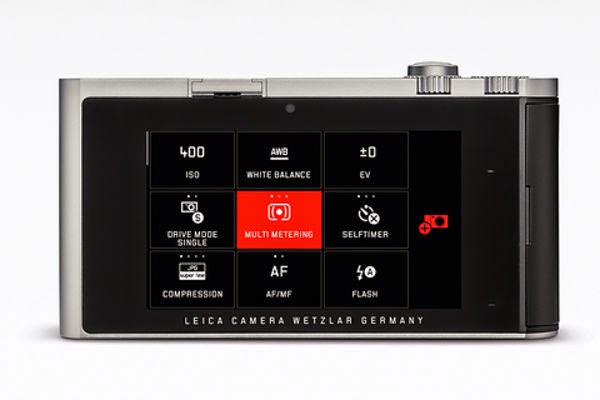
Me: Well it has a screen in the back, and two wheels on top. You choose the settings by touching them on the screen. And once the camera is set all you need is to choose the aperture, and the shutter speed on the wheels.


HCB: seems a bit slow, and where is the OVF? 

 Me: There is none, it's the screen.

HCB: formidable. Montrez moi ca! (He tears the camera from me)

Me: All the electronics are stuffed inside the brick from here, before sealing the screen. 

HCB: Vraiment? It's really small compared to my M3

HCB's first Leica


And it's expensive?

Me: € 1500

HCB: more or less what I paid my M3 in the 1950s, less the inflation. Can I use it with my lenses?

Me: Naturellement. There is a € 600 adapter, but there is a magnification factor of x1.5

HCB: Zut alors! That makes them basically useless!

Me: No trouble, you can buy a 35/f 2  in the native format here, or a 18-56/ f/3.5-5.6 zoom.


HCB: les zooms, je déteste. I can still walk you know. But how do you focus them without a RF, un télémètre?

Me: Oh, they do it by themselves. It's called Auto Focùs.
(I let him try it)

HCB: Not sure it's faster than my eye and my hand. Ah la Leica! (He looks like a giant owl eyeing a mouse)

Me: Leica will probably keep increasing speed by firmware.

HCB: Firmware? Qu'est-que c'est ca? (I try to explain. He looks unimpressed)

HCB: not really sure I get the decisive moment with that. As you know le Cardinal de Retz  disait: "Il n'y a rien dans ce monde qui n'ait un moment décisif" ("There is nothing in this world that does not have a decisive moment"). 

Me: never say never. BTW the lenses cost € 1600 and 1800 respectively.

HCB: Zut alors! Costs an arm and a leg! How is the resolution? I use Kodak Plus-X et Tri-X. Et  deux objectifs Leitz. Un 35 e un 50.

Me: Those better than me calculated that film cameras allowed a resolution of 12 Mpx to 16Mpx in the best of cases. 

Leica T is 16 Mpx, so you shouldn't notice any difference with film, rather the opposite, more sharpness. BTW you can also add un viseur éléctronique, an EVF for better targeting...

HCB: Ah, je disais quand meme,

Me: for another € 600

HCB. It's like going to the butcher's. They sell you the cow by pieces! Ca me fait une belle jambe!

Me: … But it works also like a satellite positioning of your shots.
Latitude et Longitude, you know?

HCB: you can't stop progress of course, but I am not sure I want to reveal my watering holes to the layman.

Me: you can tag even an elephant you know?

HCB: for somebody else to kill it? Tsk, tsk…Ca me fait une belle jambe!

Me: Other than this , it connects to your portable.

HCB: I have no portable in Paradise, we communicate by brainwaves, far more practical. But even if I had one?

Me: that is the revolutionary part: it sends automatically the shots to social medias, or to your newspaper. Even if you are in Africa.

HCB: marvelous, but we have no newspapers in Paradise, it all goes through brainwaves, you know. 
BTW it's getting sticky on Earth at the moment, is it?  Killings in Ukraine, girls abducted in  Nigeria... It reminds me when I went to India for Ghandi's funeral - they killed each other by the millions you know - between Hindus and Moslems. None went to Paradise.

Me: so would you buy  le Leica T?

HCB: not sure, it looks more clumsy than my M3, but OTH she is such a sweet petite. You think they'll make it in black?


Me: Yes, absolutely. There it is, with its viewfinder,  called a Visoflex, like the old reflex contraption.

HCB: Visoflex my foot, that's an ugly bout.

OTH such a petite I could use to snap Woytila, and John XXIII, our new Saints, without their taking notice.  Their PR are calling me, allow me to leave, Monsieur, I have a job to do...

(he fades away)

There are a lot of previews, but no decisive tests yet. 
Let's say that the Leica T is in the ballpark of the Vario X, which was quite good without being overly reactive. It surely is a lovely object to own, even at moderate prices for Leica, and so it has reached the Top Ten in many sites.

There's one glitch though. At those prices everybody believed that the lenses would have no electronic correction.

It was noticed by DPR when  downloading the DNG files with two separate programs, one honoring corrections and the other not. By comparing them they concluded  Leica used software correction after all.

No optical perfection - shame and grinding of teeth :) 
Truth is that to keep the lenses small  firmware correction is needed, because of the short register.

Leica is no exception, and after all they warned that the lenses are made in Japan. In fact the new Leica is very similar to other mirrorless small format. The real difference is in the build, the haptics, and the reductionist approach in the menus.

Some call it the Apple of the Leicas.
Not a pyramid of features, but only what the user strictly needs before the shot.

 Lots of things to copy there for the other makers. Olympus take note, your menus need to be revamped, towards the same simplicity. HCB is here with me.

Now the best reviews I found, straight from the horse's mouth

* Review by Red Dot Forum
* Review by Jono Slack
* By Luminous Landscape


Meanwhile witty Leica Apostate (J. Shin) did a review of sorts about the sanding of the Aluminium block

"Giving new meaning to the phrase "manual labor". More captivating than a cat video! I mean, it's 5 am, and I'm actually watching the whole thing!
And now we know why it's $1850, not $1800.
I wanna know how he talked his boss into letting him get paid to do this. Who is his agent?
Can you imagine the ad for the job? "Must have the ability to discern minute irregularities on brushed aluminum surface."
And who is the cinematographer? What patience!
At 10:35, he actually uses a sander. [added later: the only time he does it!] You can hear someone else using something mechanical in the room.
Notice how he has to hold the sandpaper in place. No shortcuts at all.
14:48 The gloves are on! There is water! OK. That's another $50.
Imagine if he messes up one stroke. Or gouges out the lens opening. Back to the start with a 1.2 kg block of aluminum.
I mean, Leica's taking this "jewel" business seriously, aren't they. I'm thoroughly impressed.
Can we just pay him the $1850, not Dr. Kaufmann?
In the US, if a woman did the polishing, it would be worth only $1480. $1665 if she is not on "mommy track". How is wage parity in Germany?"

(The rest is here)

Would I buy it? If I had the money, surely. Just for the sake of caressing sensuously her beautiful anodized (?) body. I'd call her Titania, like in Shakespeare.

However it would still not replace my middle class Olympus E-M5. It has buttons and wheels and also a touch screen, but I never use it, you can't teach an old dog new tricks, they say.

 And the Leica T doesn't have a built in viewfinder, a must, according to me. They say that at Wetzlar, where they sand the body, they couldn't resist to build the Leica T in one block, and so the hump for the EVF had to go.


Wednesday, 16 April 2014

Olympus in-Camera magic: the OM-D series,

(Warning! Contentious content)

Some people are used to give female names to their camera. I don't but if I had  to, i would give it Mélusine, the name of the Queen of Fairies, with the tail of a Siren, so well she supplements the needs of Imagination.

When the E-M5 appeared almost 3 yrs. ago, the mirrorless m4/3 format was still immature: slow AF, mediocre sensor, low sensitivity to light, restricted Dynamic Range. All it had was small size and better image quality than the so called Point & Shoot cameras.

Then suddenly all problems were solved, everything fell into place, and we had a jewel of a camera whose whole was more than the sum of its parts. When Steve Huff made one of his Strange comparisons against the Leica M9 he defied his audience to tell which shot was which.

The E-M3, a black beauty.

To me its is still a recent buy, but from the beginning it has somehow changed the way I shoot. By offering a tolerable EVF of some 1.4 Mpx and a small dSLR form factor it brought me back to my film times. But by giving me separate wheels for aperture and EV controls, plus a manifold of buttons to change the settings it has made for me even more useless Photoshop and PP. DPReview however was the first to notice that Olympus had made the miracle of making a Jpeg processor which had as good Dynamic Range as the best result you could get from RAW processing.

I know that many will cry foul. This is a contentious issue for people who consider Lightroom their holy grail. Much good might it do to them, I consider the time saved in avoiding PP precious for further shooting.

By seeing what the sensor sees I make corrections on the spot, and I am ready to shoot in a few seconds, even with the right Art Filter if I need a special atmosphere, for tone gradation there is even a separate button.

The OM-Ds have also a nice feature called Live Time. When shooting at extra low shutter times, the camera shows you an image emerging from the screen, so that you can stop the exposure any time, when you are satisfied with its brightness. Live Time makes it easy tomake such effects, like light-painting:

courtesy Steve Huff.
On the side of reactiveness,  not only the AF is lightning bast. The back screen, a great bright OLED  is touch sensitive, and has touch shutter: you select the area AF by touch, the camera does it and shoots instantly.

Priceless: when using it from the navel, people never notice you, especially if you have a wide angle pointed in a different direction, but they are still within the frame. OTH you can completely shut down the back screen, and use the EVF instead, as if it were an ordinary dSLR: great in bright Summer days, and great on batteries.

Now about the debate Jpeg vs. RAW. The difference is not in the recording format, but if and when you do a photographer's work. You are not collecting Kellog's Mickey Mouse piccies like kids after all, are you? One must be ready to catch reality, and if that reality is dead, because it is PAST, no exotic processing is going to save your skin.

Reality must be caught while it develops. That is the meaning of HCB apocryphal: 'I am a  hunter, not  a cook'.  We are not Digital cooks. If need be, one can convert an uncompressed  Jpeg into a Tiff, and work losslessly for minor corrections. Don't invent a fake world at the expense of a snap!

With the OM-D Olympus gave the possibility of preparing a perfect image BEFORE the shot, which a photographer should always attempt. Thinking that one will save the image later and correct it is just an illusion - treating photography as if it were  a painting, adding layer upon layer, an additive art, which it isn't. Better choose the right light on the scene, instead of brightening later on the computer. At the worst learn to use a speedlight - you are still using real light! Photography is about Light, not about layers of painting.

A proof? If you have a high number of keepers from the start you won't be interested in spending hours in the digital lab. You'll be more interested in spending that same time on the field in catching the visual opportunities. And this will result in a higher number of keepers.

Now what is a keeper and what is not a keeper? If you are on flickr, you know that others will rate your pics, and  that they almost never rate the camera, or the processing, but content, the decisive instant.

They will be indifferent if it is a Jpeg or a Tiff, and they will certainly not rate a RAW. They will rate if the picture is timely or not. The same will happen in contests.

All this wouldn't have happened if Olympus and Panasonic hadn't introduced the view from the sensor instead of the traditional dSLR view from the lens. EVF allows WYSIWYG and it is the whole difference: like going from a geocentric astronomy to heliocentric. You compose everything  on the LCD. Bye bye, Photoshop!

The E-M1 was the first to sport duplication of functions by WiFi on a  smartphone.

Now back to the Olympus cameras. Later models have refined the concept and added innovative features.
The expensive E-M1 introduced PDAF in addition to CDAF (Phase AF + Contrast AF). This allowed to use over 30 High Quality lenses of the earlier 4/3 system and use them at their native speed, which had been impossible with the E-M5. 
  It added also HDR in camera and Time Lapse Movies. A Color Director - I could also see its uses, next to Tone Control. Again something you don't need Lightroom for anymore

Introduced later this year, like in the E-M1, the economy E-M10 added Wi-Fi, which allows to download, or better upload piccies to your favorite social sites on the fly.
The E-M10 sports a new pancake zoom kit lens

Thus you can see a new concept emerging in photography: not  a work of art or better an overprocessed monster, slowly cooked in PS, but image as instant communication, to be corrected later in Instagram or Snapseed if need be, if you want to add to the fun. Otherwise just plain, stark photography, directly uploaded on line. Communication first, musings later.

Besides WiFi also allows to literally to drive the OM-D on a tripod from the phone: again WYS in the phone is IWYG from the camera. Isn't it neat? You can 'touch' the camera from the phone!

Another feature all those fairy cameras have is strong IBIS, meaning that you have rock steady AF, a thing that only steadycams could provide in the past, with a heavy expense and with a cumbersome equipment. Now it works with a slight buzz, as if by magic. Or the whirr of invisible gyroscopes. In fact Olympus made the sensor levitate!

 That means shooting with a 3-4 stop advantage in low light. You can also shoot movies, which are absolutely steady, including the image of the viewfinder.

This combination of features has resulted in an industry standard that other brands have trouble to follow.  This disruptive  technology has created a cognitive gap with other users, that is why I have trouble explaining why I am not interested in Photoshopping anymore and I have switched instead to  the 'Slow Photography' paradigm.

When I tell DPR forum users the above they can get very angry, but that's the mere truth: disruptive technology can change radically one's habits, and sometimes for the best.

I have been accused of using Olympus' Art filters in place of PS, in a crude way. But the truth is that I like them crude, exactly like B&W is a strong transformation of colour. I like them not for realism, but from distancing from the real in a critical way. For instance to show how hard underprivileged environments can be. I am not into the beautification of marriage photogs. or other commercial shooters.


A tip about the lenses

Strong IBIS and good sensors have much reduced the need of fast lenses - this is another contentious argument. Be against or for, my pleasure. But I will give my opinion:

People have forgotten than in film times there were plenty of 2.8 and even 3.5 great primes optimised for resolution and small size. Last century. Leica 3.5 lenses were not rare, and so Zeisses and other wonders: the best pancakes ever made for rangefinders.

Lenses below 2.0 were rare, big and mostly used for Portrait or Fashion. Now in the consumerist age everybody seems to have learned the worst from Marriage photogs. , but the truth is that fast and sharp exclude often each other. 

Example: the PanaLeica 25mm has half the resolution at 1.4 it has at 2.8, Lensrentals discovered.

So people get lenses that are fast and sharp, but only at smaller apertures, and pay big bucks for the privilege, LOL.

Zeiss knows since it just provided the Sony A7 with a 35/2.8 for small  size and sharpness.

But what do people know? In fact with short distance to flange it is v. risky to make fast lenses, especially in wides, for resolution drops at the edges since they are not telecentric.

Better have a moderate aperture and exploit the sensitivity of the sensor, exactly like Sigma is doing with its Art DN Series, if one wants sharp across the frame. These lenses are resolution champions  for Micro 4/3 and they cost 1/3 than those of other makers. Just check them at Lensrentals.

The Sigma Art Series for m4/3 system, all f/2.8
BTW sharp and high resolution are not the same. Sharp is subjective while resolution is measurable.

Most of my lenses are 2.8, and believe me I don't feel limited at all. In low light Auto ISO can to to 3.200 or even 6400 and IBIS allows me to shoot at 1/10 s perfectly stable at 2.8. What else do I need? That is candlelight.

People object: but you don't get nice bokeh. I reply get close to your subject and you'll have all the bokeh you need at 2.8. 

Besides I, consider bokeh  a dirty trick issued from the beautification drive of Marriage photogs.  - a drive towards fake photography as fake as it might be. Women without pimples or freckles.

Again this has nothing to do with Slow Photography, which is rather on the side of f/64 and the Stieglitz camp. Again YMMV, as they say. But a Camera is first and foremost a perspective machine. Why waste your DOF by blurring everything?

Feel that I have been unfair or unjust towards PP? Feel free to comment. If we are many we might even try to make a poll.

My Black Queen, with gaffer's tape over the Logos.