The latter is the title of the famous book by Lucy Lippard, by which in 1972 she gave the first intimation about a new movement in art which encompassed concept or idea art and such diverse labels as minimal, body art, land art.


"In a letter to Alfred Stieglitz (22 May 1922) Duchamp, having noted photography's displacement of painting, suggests that photography itself may one day be replaced: "You know exactly how I feel about photography. I would like to see it make people despise painting until something else will make photography unbearable". By 1922, the success of photography as a medium of mechanical reproduction was already challenged by the emergence of other media, such as cinema. Photography's "fidelity" and "originality" as artistic reproduction, however, will eventually face the greater challenge of its mass reproduction and circulation in print. Thus, while photography calls into question the autonomy of painting as a medium for artistic reproduction, it may fall victim to the reproductive technology that first made it possible.


Note the interesting pictographic interpretation of the picture in the left side.
Photography is a young art, in fact the youngest, with a fairly good nexus with reality, given by its non interfering, automated nature. Why waste it? Instead use it for controlled experiments, if you want to better understand the nature of reality. Self referential Art will never provide an answer.
After Mark Rothko and Nyman's Field Colour painting, while Warhol was closing with hyperrealism the decade of Pop art, painting and the use of canvas seemed to have reached the bottom of the barrel.
As Lippard mentions artists seemed to have the need to reach out of New York, out and away from the incestuous closed loop of galleries, critics and museum curators. Some headed to the Nevada desert, others did performances on roofs or in run down apartments, and others, like On Kawara started mailing postcards from every part of the world.
As Lippard mentions artists seemed to have the need to reach out of New York, out and away from the incestuous closed loop of galleries, critics and museum curators. Some headed to the Nevada desert, others did performances on roofs or in run down apartments, and others, like On Kawara started mailing postcards from every part of the world.
Where do cameras and photography fit in in such movements?
According to David Bate, the medium was so instrumental in documenting conceptual performances, that it opened the doors of the Tate Gallery in 2003 to content related photography.
But was there ever Conceptual Photography? In 1975 I was working as a shop assistant in one of the main conceptual art galleries, the Sperone & Fisher in Rome. I guess that Sperone had got affluent by selling Warhol's litographs to Count Panza di Biumo, who was assembling a mighty collection of postwar American artists in his castle in Turin. Sperone introduced him to a whole new stable of artists whose expressive means where ideas, and not canvas or scupltures.
 |
| Lucy Lippard in 2011 |
Those of course had to be documented in order to be sold, and therefore the final work often took the aspect of photos. Of prices I had no idea, I was simply in charge of sending invitations for the openings, and allow visitors to take a tour.
 |
| Jan Dibbets'Sea at Fischer. You can see at the same time what you have in front of you as well as what you have in your back. |
By my personal recollection the artists that were more related to photography as content were Dutch Jan Dibbets, working on perspective illusions, Richard Long and Hamish Fulton, who were crossing countrysides in order to achieve some project.
Hamish Fulton pictures have a romantic flavour even if issued from an iron determination:
 |
| Hamish Fulton |
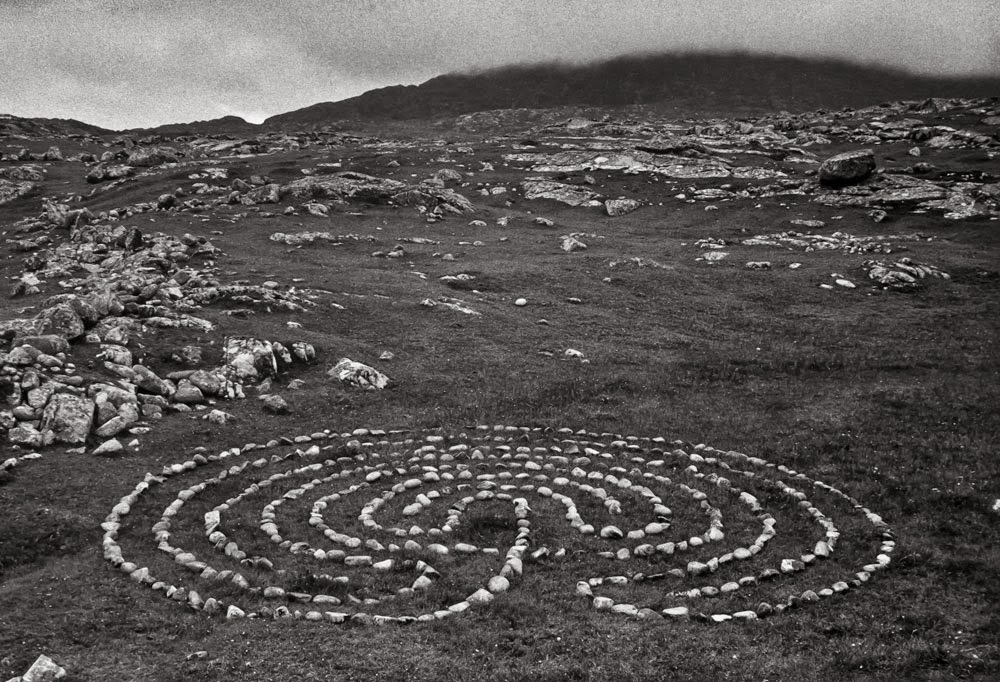 |
| Richard Long, Connemara. |
As for Dibbets, this is how the NT times recorded his
'Work from Perspective Correction, Land and Sea Horizons, and Windows':
“The camera records something quite different from what we see. There are no rectangular formats in nature, only in art (paintings, sheets of music or poems, windows, ravioli), and only if we choose to look at it that way. For Perspective Correction, My Studio I, 1: Square on Floor, 1969, the earliest work in the show, Jan Dibbets drew an upside-down trapezoid (in relation to the camera) on his studio floor and took a photograph (the work) so that the trapezoid, distorted by perspective, appears to be a square. It’s difficult not to think of it as a square, and no reason not to, despite the inward-slanting walls. In a way it is a joke about the preeminence of the picture plane in contemporary art, whereas, of course, the perception of Renaissance perspective still prevails, or at least still resides, or better yet is still the place where we and the artist reside. Despite the square, our eyes take us into depth to the windows and their light. There are windows within a window presaged by another window. Without really destroying our illusions, the artist has interrupted reality, or intervened to almost imperceptibly create another reality, something in the back of the mind that forces us to accept both realities. The artist introduces himself (takes control?) by making a square out of a trapezoid in his own studio. The trick is an elementary one, a wan display of the human imagination. But it suggests something more elemental, in itself and in works to come.” - Donald Goddard

“Jan Dibbets’ series “Land And Sea Horizons” juxtaposes photographs of dunes and ocean, each mounted in different shapes and formats. The viewer sees simultaneously what would be in front of and what would be behind him in a real landscape. This experience is further stimulated by the fact that although the panels are pieced together in different ways, the horizon line always remains level and constant .
What I found fascinating was the difference of approaches to 'Art' once the canvas had been left behind.
“Jan Dibbets’ series “Land And Sea Horizons” juxtaposes photographs of dunes and ocean, each mounted in different shapes and formats. The viewer sees simultaneously what would be in front of and what would be behind him in a real landscape. This experience is further stimulated by the fact that although the panels are pieced together in different ways, the horizon line always remains level and constant .
What I found fascinating was the difference of approaches to 'Art' once the canvas had been left behind.
Gilbert and George usually portrayed themselves as romantic gentlemen in the search of Goddess Art:
"How can one be fully with art? In other words, can art be experienced directly in a society that has produced so much discourse and built so many structures to guide the spectator? Gilbert & George’s answer is to consider art as a deity:
“Oh Art where did you come from, who mothered such a strange being. For what kind of people are you: are you for the feeble-of- mind, are you for the poor-at-heart, art for those with no soul. Are you a branch of nature’s fantastic network or are you an invention of some ambitious man? Do you come from a long line of arts? For every artist is born in the usual way and we have never seen a young artist. Is to become an artist to be reborn, or is it a condition of life?” With a good dose of humor, “the human sculptors” suggest that art needs no mediation. Because artists refer to a higher authority, no curator or museum is to stand in the way.
Meanwhile Bernt and Hille Becher were achieving a classification of German Industrial Archaeology. I was never interested in morphological classification, but they certainly started a trend in Industrial Archaeology, while the Ruhr German industry of the 1950 was going to the dogs, furnaces and smelters. Method can be visually striking, and useful too.
From these I learned the importance of having projects, even before starting to shoot.
Conceptual Art was never really the same thing of Photography. In the beginning it was an Art & Language thing, dedicated to clarifying which objects and activities might be defined as Art.
Joseph Kosuth and Lawrence Weiner were among the most proeminent in using writing and dictionary definitions to frame a definition of Art.
Joseph Kosuth and Lawrence Weiner were among the most proeminent in using writing and dictionary definitions to frame a definition of Art.
 |
| Joseph Kosuth. Definitions. |
It was Kosuth, a squat blonde always dressed in black like a clergyman, who was to develop the theme of Art as Idea. It made my head spin, since it used high level formal logic:
"The nature of art should be the main concern of artists. Remaining within traditional categories of painting and sculpture, however, obstructs such inquiry since these artistic categories are conventional and their legitimacy is taken for granted. Thus these categories should be disavowed, regarded as anachronistic, useless, even detrimental, to artists."
This main line of argument leads Kosuth to reconsider the history of modern art as it is conventionally narrated, and to dismiss the relevance of artists such as Edouard Manet, Paul Cezanne, and the cubists, whose work as art he deems valid only on morphological grounds, that is, only insofar as they remained tied to the medium of painting.
Instead Kosuth champions an alternate canon of art—one that is characterized by the subversion of the old classifications—represented by his understanding of the legacy of Marcel Duchamp.
 |
| J. Kosuth |
Kosuth brackets off and expels any questions of a referential dimension from his theoretical model, concluding that “art’s only claim is for art. Art is the definition of art.” (Conceptual Art: A Critical Anthology, Alexander Alberro, Blake Stimson, MIT Press)
I admired Kosuth's consistency but I wasn't fully convinced of Art self-referentiality. Every time that painting or poetry had chosen such a way, l'Art pour l'Art, in the long history of Art there had been a loss or a defeat. OTH I agreed that Art could not be defined anymore by the use of the canvas.
Meanwhile Sol Lewitt and Carl Andre, made geometrical installations which dealt with space visualization of abstract or mathematical projects. I met most for dinner and they were a simpatico bunch despite their ambitious projects. A bolding bespectacled intellectual type of New Yorker the first, and a sturdy rail worker, as he had been, the second.
 |
| Carl Andre, installation. |
 |
| Sol Lewitt, installation. |
The one I sympathized most was fellow citizen Alighiero Boetti, making maps of World with flags and lettering tapestries, weaved in Afghanistan, where he had spent years. He had an Afghan butler and was living in a large empty flat facing PIazza Trastevere, a haven for dropouts and addicts. He himself was not above opium, and had an intelligent, dissolute air like some dropouts I had met in India.
In fact he didn't make his tapestries but actually ordered them, from thousands miles away.
In fact he didn't make his tapestries but actually ordered them, from thousands miles away.
 |
| Two tapestries by Alighiero Boetti |
An Italian group around critic Germano Celant and Arte Povera had in some ways anticipated the American side of Conceptual Art.
With Fabro, Zorio, Merz and Boetti himself, Celant had put together a nice group of artists who sold in Germany. In Italy abandoning the canvas was still considered in poor taste.
Differently from the Americans they always kept a tactile aspect to the works and refrained from purely verbal definitions. Unfortunately there was nothing for photography there, but to document the works.
Differently from the Americans they always kept a tactile aspect to the works and refrained from purely verbal definitions. Unfortunately there was nothing for photography there, but to document the works.
 |
| Mario Merz, Fibonacci's progression. |
In fact the issue if the camera was a significant or indifferent addition to the artist has been adressed by Marcel Duchamp in NY 40 yrs. before, at the 391 gallery of Stieglitz and Steichen.
 |
| M. Duchamp. Large Glass. |
 |
| M. Duchamp, Hour |
It is this particular "fatality" of an artistic medium, its vulnerability to technical conditions, that fascinates Duchamp, particularly with regard to painting and sculpture. The viability and legitimacy of these media, identified with classical conceptions of art, are at stake in Duchamp's exploration of their putative "end," or rather, "death." - Unpacking Duchamp, Art in Transit, Dalia Judovitz, UC Press)
Now let's see some early examples of this seemingly chaotic 'Idea' or 'Concept' movement, and their relation if not to photo, to visual art. It might help in this very moment mass photography by the billions seems to obliterate any structure or intention.
 |
| Sol Lewitt |
Sol Lewitt (1967):
"I will refer to the kind of art in which I am involved as conceptual art. In conceptual art the idea or concept is the most important aspect of the work. When an artist uses a conceptual form of art, it means that all of the planning and decisions are made beforehand and the execution is a perfunctory affair. The idea becomes a machine that makes the art. This kind of art is not theoretical or illustrative of theories; it is intuitive, it is involved with all types of mental processes and it is purposeless. It is usually free from the dependence on the skill of the artist as a craftsman. It is the objective of the artist who is concerned with conceptual art to make his work mentally interesting to the spectator, and therefore usually he would want it to become emotionally dry. There is no reason to suppose, however, that the conceptual artist is out to bore the viewer. It is only the expectation of an emotional kick, to which one conditioned to expressionist art is accustomed, that would deter the viewer from perceiving this art."
Indeed Lewitt invited other people to draw lines for him according to plan, i.e. not touching.
Indeed Lewitt invited other people to draw lines for him according to plan, i.e. not touching.
 |
| Sol Lewitt |
In this sense a preset camera is the perfect machine for making conceptual art while postprocessing is only a residue of painting.
Meanwhile On Kawara in 1967-68 kept sending from Brasil to Lucy Lippard dozens of postcards at regular intervals with his longitude and latitude - "a kind of reassurance that the artist does in fact exist. At the same time they are totally without pathos" L.L.
.jpg) |
In those early years C.A. could easily be related to other genres, provided that they avoided the canvas, like Body Art or Land art. In an 1969 Interview Robert Smithson stated some interesting concepts.
Deborah Walter: "By working wih different materials, Smithson challenged the artistic meaning and the artistic act. Since he stopped painting, he had shown preference for raw material – such as soil, minerals, and rocks – instead of anything refined such as oil or acrylic paint.
|
 |
| R. Smithson, Asphalt Rundown. |
"Perceptions of presence and absence, existence and non-existence, past and present are constantly being called into Smithson’s works. Not only in his sculptures but also in every other media he had used. He was interested in aspects of time, space and changes, natural history and geology. These were current in his texts and art, which actually could barely be separated. Smithson was concerned with habitual frames and limits of art. Though most his sculptures relied on documentation (photographs, maps and texts), there was no secondary media of presentation but they all existed simultaneously.
 |
| Smithson's Jetty |
His photographs, for instance, are an alert to the idea of constant changes, evidences of past, remaining pieces for the future. Smithson’s photographs registered and preserved a moment in time whilst the sculptures would eventually vanish. The photographs registered the sculptures, the ephemeral. As an artwork, the site-specific acquired the quality of what could not be maintained, kept, or sold. The art critic Craig Owens stressed that “the site- specific work becomes an emblem of transience, the ephemerality of all phenomena; it is the memento mori of the twentieth century”.
Unfortunately Smithson was to die young in 1976, so we have relatively few works of this interesting if ponderous artist. Most of people never saw in person his works made in distant places, but only the photographs. Again the forensic aspect of photography, giving proof of a reality which can't be seen.
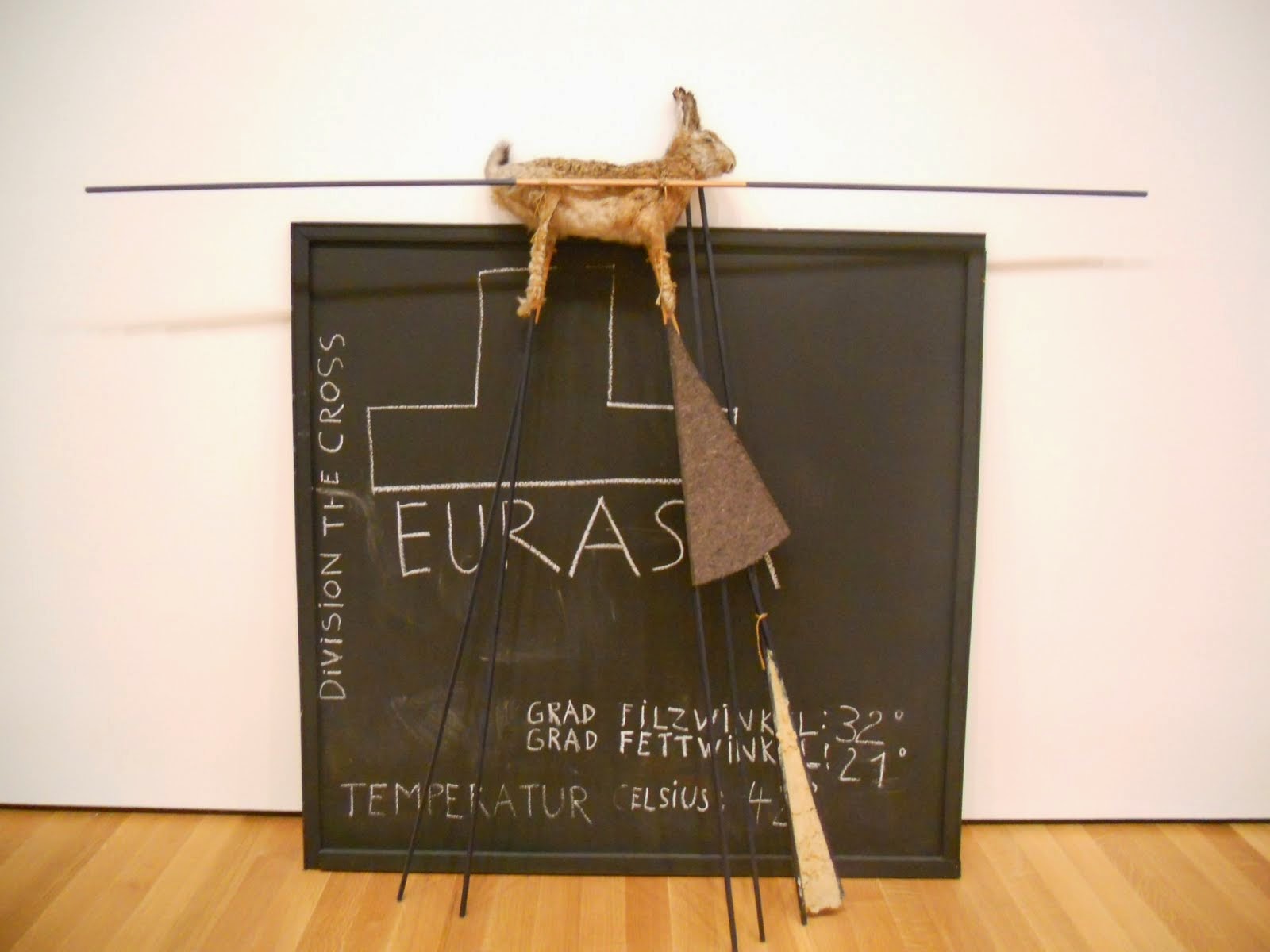
Meanwhile Joseph Beuys was assurging to first magnitude, with its ecological Pieces, like Eurasia
Interview with Willoughby Sharp:
"The origin of the flow of information comes not from matter, but from the “I”, from an idea. Here is the borderline between physics and metaphysics: this is what interests me about this theory of sculpture. Take a hare running from one corner of a room to another. I think this hare can achieve more for the political development of the world than a human being. By that I mean that some of the elementary strength of animals should be added to the positivist thinking which is prevalent today. I would like to elevate the status of animals to that of humans".
 |
| Beuys'Coyote |
No wonder that witnesses described Beuys as sweating, and exhausted at the end of his performances!
For me the work of Beuys has kept by far being the most enigmatic of all, perhaps because it had a shamanistic side dealing with animals and their energy, and therefore is not easily translated into words. Perhaps I am still wordcentric after all.
For me the work of Beuys has kept by far being the most enigmatic of all, perhaps because it had a shamanistic side dealing with animals and their energy, and therefore is not easily translated into words. Perhaps I am still wordcentric after all.
Meanwhile Lawrence Weiner kept publishing small books, with definition essays, at Aaschen, in 1970:
to the sea
on the sea
from the sea
at the sea
bordering the sea
to the lake
on the lake
from the lake
at the lake
bordering the lake
They needed no art object anymore, and not a even photo reproduction.
I remember Weiner's country preacher appearance, due to a long beard and his shabby dressing, in funny contradiction with the exactness of his statements.
As Deborah Walter comments about the use of words:
"Conceptual Art literature bears a thoughtful contribution on narrative, authorship and reception. Artists often refused the taxonomy of poets, for their literature was to promote new readings ahead of artistic demarcations. The presence of words emphasized the opacity of language in two ways: in both its plastic, solid characteristics and the amplitude texts could reach. Language in Conceptual Art also contributed to the questioning of the long-lasting art object; it suggested a less alienated social function of art and artists, and it turned viewers/readers into active participants in the reading of art. Thus, language became a revolutionary tool in Conceptualism having an important effect in the arts to come."
There was also room for non verbal and metaphysical action however, like in Peter Huchinson's Dissolving Clouds:
 |
| P. Hutchinson, Dissolving Clouds |
"Using Hata Yoga's technique of intense concentration and pranic energy it is claimed that clouds can be dissolved. I tried it on cloud (in square) in photographs. This is what happens. "This piece happens almost entirely in the mind"
Photography plays the usual role of silent witness, as a proof of reality of a kind.
Meanwhile Hanne Darboven went on with her writing projects of covering notebooks, and even books, with permutations of numbers or letters:
A dizzying experience I can swear, but v. little for photography.
A bit different William Wegman's Parrot-Crow, an image betraying expectations
"At first glance, this photograph appears relatively straightforward: a stuffed parrot is positioned on a pedestal, illuminated by dramatic, ominous lighting. Upon closer inspection, though, it becomes clear that there is a sight gag occurring in the background. The shadow cast by the parrot is not the parrot’s own, but rather that of a crow. The photograph functions, on one level, as a visual joke, delivered with William Wegman’s characteristic deadpan irony. At the same time, by demonstrating how a photographic image is not necessarily a “true” transcription of reality, Crow engages in a distinctly postmodern critique of traditional assumptions about the photographic medium." (Withney Museum of American Art)
As conceptual Art unfolded, so did the new interpretative techniques of semeiotics. Interestingly ithey are here applied to British photographer Victor Burgin, who was also a conceptual artist:.
From: George Dillon, Art and The Semiotic of Images:
 |
| Victor Burgin, Zoo |
"Though pictures are quite different from texts of natural language, they are not wholly different, and many have sought parallels between the two media. Like texts, most pictures are composed of parts, though the parts are bits of image (and perhaps words) arranged on a surface. When the various shapes in a picture wash and flow and blend into each other and the background, they do not seem very much like words, but when they have crisp edges, as for example in the Dada photomontage introduced here, they have attracted the term "word" and their arrangement likened to a syntax."
As for me, in a pictographic context such as this blog, I consider the whole as a Rebus, a puzzle which is to be decoded by relying both on image and word. Words can also be uncoupled from pictures in a détournement (diversion):
 |
| Victor Burgin, Office at Night |
This detournement of images (Diversion), the changing of the function of the image by text was also made in the same years by Internationale Situationniste, a political and art avant garde that led to May 68 in Paris.
As for Photography it is difficult to know what it got from the Conceptual trend. Perhaps the need of consistency and the need of a project even before starting to shoot. Photography like Cinematography is lucky to have a direct link with reality, even if it sometimes seems fettered to it, I can always go back to it, while painting is always at the risk of being waylaid by abstract ideas.
As a movement Conceptual Art cast a net much wider than I have described. There are tons of other interesting artists.We are lucky to have this, for further consultation online.
Conceptual Art was really an international movement, the last attempt at globalization by photographic paper, or by fax, before the WWW really began. It broke down the gallery-critic- museum closed circuit, but only to return to it as photos and videos.
It was also the Art of the Vietnam War, in that it destroyed the idea of a Western-centric Art, and yet confirmed it again. Only the WWW has succeeded in making photo and Art acephalous and centerless, although Museums still exist. But are they relevant anymore?
It was also the Art of the Vietnam War, in that it destroyed the idea of a Western-centric Art, and yet confirmed it again. Only the WWW has succeeded in making photo and Art acephalous and centerless, although Museums still exist. But are they relevant anymore?
 |
A reconditioned comic strip by Internationale Situationniste. |
Finally, for videographers I would like to add this ingenious performance made by Dan Graham in 1969, Two Correlated Rotations.
Is it a way to overcome subjectivity, by presenting simultaneously two points of view, each performer having a camera.

"2 super 8mm films. Two cameramen each hold cameras so that their viewfinders are extensions of their eyes and visual fields. They begin facing each other one foot way. They walk in counter spirals, the outside performer moving gradually outward while the inside performer walks inward approaching the center. Their aim, which is still in the sate of a learning process, is to as nearly as possible be continuously centering their cameras (and eyes) view on the forntal eye position of the other. Geometrically the rotation of the performers' encks and also of their path walked keeps the camera/eye sight lineof both cameras' images along the axis of the horizon line of the 360 surrounding space; the line of sight of both cameras' images when the cameras are facing each other passes through the center of the spirals and the interior of the 360 topological spatial enclosure."
I suppose that today you could repeat the performance in digital, and see what is happening in real time on a large video monitor split in two. Media get improved but good ideas live on.
I can also see a surrealist scene where two camera holders meet on a country road, and start circling around each other, and sniffing at each other like dogs, with their zooms like snouts. A dialogue a' la Beckett ensues, and they end up comparing cameras and features, until one comes up with the idea of having a pint at a nearby pub. :)
Is it a way to overcome subjectivity, by presenting simultaneously two points of view, each performer having a camera.
"2 super 8mm films. Two cameramen each hold cameras so that their viewfinders are extensions of their eyes and visual fields. They begin facing each other one foot way. They walk in counter spirals, the outside performer moving gradually outward while the inside performer walks inward approaching the center. Their aim, which is still in the sate of a learning process, is to as nearly as possible be continuously centering their cameras (and eyes) view on the forntal eye position of the other. Geometrically the rotation of the performers' encks and also of their path walked keeps the camera/eye sight lineof both cameras' images along the axis of the horizon line of the 360 surrounding space; the line of sight of both cameras' images when the cameras are facing each other passes through the center of the spirals and the interior of the 360 topological spatial enclosure."
I suppose that today you could repeat the performance in digital, and see what is happening in real time on a large video monitor split in two. Media get improved but good ideas live on.
I can also see a surrealist scene where two camera holders meet on a country road, and start circling around each other, and sniffing at each other like dogs, with their zooms like snouts. A dialogue a' la Beckett ensues, and they end up comparing cameras and features, until one comes up with the idea of having a pint at a nearby pub. :)