Showing posts with label psychology. Show all posts

Sunday, 20 April 2014

'Nadja', a follow up.

* Warning: Intellectual stuff! - jump altogether if you are not into psychology and deconstruction.

My friend Daniel Jouanisson, videographer, sent me this photo update on the squares of Paris in 'Nadja'. Judge yourself how little they have changed in almost one century!

Hotel des Grands Hommes
How important were those squares for the  the story of Nadja? Here is another interpretation by Critic David Bate, from Westminster University in 'Photography and Surrealism' .

Deconstruction technique is interesting here because it allows to get to the bottom of the most indifferent image, and extract its true meanings. Remember: no photograph is innocent!

You can always connect it to a context, to a choice and a photographer's point of view. Here we are told about Nadja's madness, so pychanalysis is suitable, and it might even explain the hidden meaning of those sad squares that populate the book.

In his book, Bate relates Surrealism and Sexuality, giving an explanation to the Enigmatic.

Some images draw us, even if we don't know why. Interpretation can provide the explanation. Finding the culprit is like finding a serial killer by Forensic Science. 
Out of necessity the language is specialized. My comments will try to clarify.

David Bate: "The photographs in 'Nadja' echo this structure of loss through their emptiness. As the reader views the photographs in relation to the text, the pictures are dis turbingly empty, 'lacking' in actual events. Looking into these photographic spaces where any decisive momenthas 'disappeared', we wonder what is the other there. 
Just as Nadja loses her image of identification, so the 
reader of Nadja is deprived of a reflected identification 
in the photographs. Most of the photographs, even the 
portraits, have a mute and mournful look, there is a 
'dinginess' in these pictures, rarely noted by commenta- 
tors as such, through which their 'mood' of emptiness 
invades the book. 
Expecting to find photographs of the events in their captions, the reader finds them lacking and it is in this way that an enigma emerges".

In the book the onset of the Enigma is also marked by the impromptu appearance of a fortune teller:


When Nadja told Breton she saw herself as Helene, Breton was reminded that a clairvoyant had predicted days before their meeting that he would get involved with a Helene. Another unlikely coincidence!
Breton and Nadja are approaching the Unconscious zone, which is timeless. They can meet, but they can also differ, having different unconscious goals.

David Bate: "Towards the end of Nadja, Breton says that he wanted some of the photographic images of the places and people to be taken 'at the special angle from which I 
myself had looked at them'. This proved impossible; 
the places 'resisted' this and thus, for Breton, 'as I see 
it, with some exceptions the illustrated parts of Nadja 
are inadequate'

"Breton mythologizes these places, as having some- 
thing in them which resists representation. This only 
makes those places gain in enigma. There is little or no 
attempt to show things as literally from Breton's point- 
of-view in the photographs. In the photograph of Place 
Dauphine, the view is outside, looking in. One would 
have to be a disembodied voyeur to be able to 'see' what 
cannot be seen in these photographs. Whatever Breton 
says himself in the book, the photographs make crucial 
contributions and their presence gives a distinct feeling 
to the book. Can it be that this is what Breton meant 
when he described the photograph as 'permeated with 
an emotive value'?"
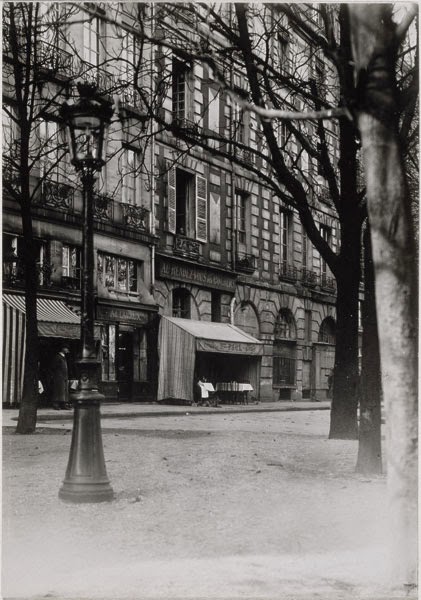

                    The uncanny Place Dauphine, where Breton and Nadja were to have dinner.

What is not said is that most of those somber Paris' squares in fact have been the theatre of acts of blood. In Place Dauphine was executed Jaques de Molay, the Master of the Knights Templar. Nadja perceives it and exclaims: "Et les Morts, les morts!" - she can feel the dead, she registers them. She predicts a black window turning red, and a few instants later a window lights up showing bloody red curtains! 
Another of those squares they meet at is where Marie Antoinette was beheaded. Those are not innocent places. They carry the mark of the public execution of a paternal figure.

"'Sadness', says Julia Kristeva,'is the fundamental mood 
of depression.' Certainly the photographs in Nadja are 
not joyous, they resonate with solitude. The ghosts of 
'whom I haunt' appear through their absence; as in the 
solitude of the child at the primal scene, with the parents 
'away' enjoying themselves. In this paradoxical signifying 
structure the signs are empty but never 'empty', they 
still signify. The enigmatic message of emptiness draws 
us back to those feelings and affects in the story of 
Nadja, where madness and sanity are combined in 
the mood of melancholy sadness. This mood is based 
on an identification with the lost object, where the 
depressing and depressed feelings hide an aggression 
against that object." [The Father Figure, she identifies Breton with]

"Nadja is a story in which Breton nevertheless undoes 
himself a little. He is clearly haunted by Nadja's 'madness' 
and the experience of their encounter — even if, as a 
trained psychiatric nurse, he can still say: 'You are not 
an enigma for me.'

"Meanwhile, the eyes of Nadja,repeated insistently
 in Man Ray's montage of them in Nadja,
 place Breton and the reader under her surveillance 
(an image added by the author in 1964)."


"The book ends famously with the seemingly im- 
promptu and rushed conclusion: 'Beauty will be CON- 
VULSIVE or will not be.'The 'beauty' here for Breton is 
the hysteric in convulsion, but in the end, Breton remains 
on this side of the symbolic order, he is the neurotic 
witness to his own unconscious conflicts, while Nadja 
is given to signify the unconscious and can no longer 
bear witness to her own thoughts. 

"Nadja transgresses the symbolic order and pays the price of incarceration. As Simone de Beauvoir wryly notes: 'She is so wonderfully liberated from regard for appearances that she scorns reason and the laws: she winds up in an asylum.'"

"The paths of the sexual question 'Who am I?' are 
different for the man and the woman in 'Nadja'. The 
different trajectories relate to the different relations to a 
paternal image. If beauty is hysteria, it is in the opening 
up of an identification with the other. In patriarchal 
law, as Lacan points out, the question of 'woman' is of 
an 'identification with the paternal object' through the 
Oedipus complex. It is surely this relation that Breton 
explores in Nadja and is perhaps why the photographs he 
chooses are so emptied of such potential identifications, 
except one photograph: of himself. "


To Nadja the acts of blood make the squares terrifying, the very image of parricide, while for Breton,  they are just depressing, reminding him of his literary forebears. 

"The 'whom do I haunt?' posed by Breton at the beginning of the book is revealed as Breton's melancholic 
trawl of the patchwork of paternal literary figures 
(Rousseau, Nerval, Baudelaire etc.) emerging in Nadja
as the 'primordial' signifiers that make up his Paris.  
Breton buries himself in relations to these signifiers as 
he delves into a bit of Nadja's psychosis. His fleeting 
interest in Nadja is as link to that lost literary history"


See how the same image can bring about different responses? A realist interpretation would never have explained them. Surrealism brings to the images the powerful contribution of the unconscious. Internal feeling is as real as the material reality out there.
'Nadja' is very important for the History of Photography, because it introduces the concept of shifting signifiers - there's not a one-to-one correspondance with what the image apparently depicts.
Realism, the earlier paradigm of photography, is therefore inadequate.

Although Breton died in 1966, Surrealism continued to exercise its influence up to the 1970s, notably in the work of women photographers, such as Diane Arbus, Cindy Sherman, Francesca Woodman - who mentions explicitly 'Nadja' among her  influences. 
 With her performances and body art photographs Francesca Woodman  showed  how women can reappropriate their own bodies, by turning upside down the male imaginary.

                                             *
And now, just to lighten up, another photo from my friend Jouanisson on American Realism:


No Photo is innocent! We will soon discuss what happened to photography at the era of the internet globalization. When everything went to the dogs with a surfeit of special effects, allowed by the advent of digital. And when millions of digital images pushed aside what had been the little world of the paper image.
Stay tuned!

Wednesday, 19 March 2014

A Petite for a Camera


Users of mirrorless format Micro 4/3 will be already familiar with very small cameras, and despite this with their high Image Quality.
It is the main feature of the format that for the first time did away with the use of the mirror in digital, therefore shrinking all that was stuck around it. Never such an extreme in miniaturization was reached however. Compare the differences:


A GM1 compared to a Canon 6d  (Courtesy Joachim)

The Panasonic GM1 is smaller than my palm and fingers, and yet has the same quality of its bigger brethrens, adding a very respectable MPEG-4 video format. It has a 16 Mpx sensor that can go to up to 25600 ISO sensitivity (candlelight!) and a12-32mm F3.5-5.6 pancake zoom, with great resolution, covering from wide - typically a living room, to short portrait.

Panasonic succeeded to make it collapsible to pancake size, so that you can put it easily in your pocket.

Check the Specs here

This petite in fact is probably smaller than your smartphone, and it can  interact with it by Wi-FI.

And here we come to a user's dilemma. Should you buy this beauty, which will set you back by 600 $, or should you do away with it, by simply using a smartphone?

The difference with the latter is of course that the GM1 has interchangeable lenses, which allow better IQ.  Features and performances are like  a full camera of course, not like a phone. You don't use Apps, but the controls are already coded in the camera itself.

In other words do you want to play photographer, or geek? The difference between the two is a nightmare for camera companies. The entry-level cameras, the so called Point & Shoot, were the first to be wiped out by the extreme casualness and portability of the smartphone.

This year it was worse: system cameras, the top of the bunch, lost as much as 20% worldwide - and it is not the end yet.
While the smartphone triumphs, the camera industry goes down in flames with the last contenders at each other's throats.  Can mirrorless be an answer?

Reflex camera owners hate mirrorless  since they have no optical viewfinder.
The GM1 in fact has not even an electronic one, but does it need one? It can connect to your smartphone after all.

In a mirrorless everything is sacrificed to size. Indeed  short distance to flange allows lenses to be designed much smaller.


The crop factor also allows much smaller telephotos, so on the whole, everything gets smaller.
As a result, many leave at home  the camera bag, and instead use simply their pockets, when they need additional lenses.

In a mirrorless  even an LCD back screen allows WYSIWYG, to see what you get, i.e. what the sensor records, so you can  correct the result of the shot in advance.
Similarly one can change colour casts, tones, brightness - do essential photography, *before* getting  back at home, and  lose time with Photoshop.

In fact you can directly beam by WiFi  to your social sites. End of PhotoShop!

Last but not least, Mirrorless has also no lens calibration issues, and some of the fastest AF in the industry.

M4/3 which brings so many advantages, includes a neologism: Scalability, meaning you can choose different camera sizes for the same sensor.

Nobody forces you to have a petite like the GM1 alone,  if you want to use a bigger camera with the  same lenses.  Just get two m4/3 cameras,  say a big one for Studio and Portraits, and E-M1 - and a midget, if you want to steal pictures in the street. You stll be using the same set of lenses. Great savings!

In my case I have a  dSR- like,  the Olympus EM-5, and another Olympus, the E-PM1, a midget. The first I use for dedicated work like Landscape and Architecture - the second  as an 'always with you camera',  for Street Shooting, with a diminutive pancake, a Panny 14/2.5.
By using every day the same 14/2.5,  I can tell the Field of View by heart without even needing a framing device.

Now  let's go back to this little queen of mirrorless, the  GM1.
Because of its small button estate, it has only one Function button, and a few others, including a MF/AF one. 


Its main interface is a touch screen, and that can be a blessing or an affliction. Being so small it's very easy to bring to life the screen with the thumb holding the camera. Then the wheel around the diamond keys can easily move away the focus point from the center:

 Trying to find the GM1 problems.

Now let's have a look at the customization. DPReview says: "The GM1 has one physical customizable button (Fn1, encircled by the focus mode dial on the top panel) and five more touch controls that can be assigned custom functions. These are accessed through a 'Fn' tab on the screen. Any of those buttons may be assigned the following controls:

• Wi-Fi
• One-push AE
• Touch AE
• DOF preview
• Level gauge
• Zoom Control
• Photo Style
• Aspect Ratio
• Picture size
• Quality
• Sensitivity
• Metering mode
• i.Dynamic
• i.Resolution
• HDR
• Shutter type • Flash mode
• Flash adjust
• Ex. Tele Conv.
• Digital zoom
• Stabilizer
• Motion Pic. settings
• Picture mode
• Silent mode
• AFS/AFF mode
• Peaking
• Histogram
• Guide line
• Rec area
• Step zoom
• Zoom speed
• Restore to default

That is an enormous choice.  Probably half of the functions are wasted on you, and so on me. But how to agree about what should be kept? Do they help us make better pictures? I doubt. We play, get distracted, and forget to take pictures.
But you can also see it in another way. Once those functions are set, you forget about them, and you have a camera set to your very specific needs.

OTH it's clear that such a small camera will never have the real estate needed for all the buttons its deserves, so it has to rely on the touch screen, just like a smartphone.


That is the first reason why I hesitate to  let myself seduced by the petite. Would I ever become a touch screen addict?
The second limit is that  it has no IBIS (in body stabilization) and that the battery life is only 230 shots.

On the bright side this camera has HDR, and an i-dynamic setting which can smooth the tone curve - the difference between shadows and highlights -  in heavy contrast days.

On the fun side the GM1 has Stop Motion / Time Lapse, which allows you Koyanystquatsy effects.
DPR says: "It will capture a series of images and automatically generate a movie file of a Nightmare Before Christmas-type style. With the camera on a tripod, the GM1 will take as many pictures as you'd like, and the camera will put them together into a video for you. The original stills are saved, as well. The camera can 'auto shoot' at set intervals (you'd better be quick) or you can take them at your own pace. An overlay of the previous shot helps you see exactly what's moved." This is great fun!

If there must be a conclusion for me, is that petite cameras are  becoming more important than their dSLR alternatives, because we use them more, as everyday devices. 

I have an additional reason to be involved in dwarf camera. For short range work I use  a 28mm eq., and therefore  I must  get v. close to my subject. Such a small camera as the GM1 makes me the invisible man, like Tichy:

One last thing that puzzles me considerably. The GM1 has an electronic shutter, which is true Space Age: 1/16,000 of a second. What will it be for? Electronic shutters allow a Lartigue Effect , and that is certainly a draw for me, although it might be a con for others.


On the flip side  it has only a 1/50 synchro speed for flash, which is next to useless. At the most  you can use it to trigger faster, more powerful slave speedlights.

In any case this petite, and its successors are on my radar. They simply offer too much for the size.

You can buy it at Amazon.


Friday, 14 March 2014

To a new user asking about composition

There are no set rules for composition anymore, unless you make some assumptions. For instance Landscape is different in the Western and the Chinese tradition.
Therefore one can assume you will choose the first, and therefore you must know what Western painters did in the past.

But is your choice Landscape as a genre, or Portrait, or Still Life? Those are painterly genres, but Photography was not confined to that.

The Avant Garde in 1920-30 completely changed the painterly Rule of Thirds, which had been in charge before. It also started Street Shooting, where composition is rather in depth than on a flat    plane.
 According to D. Bate, American Street Shooting has evolved towards more Balance and Neutrality.

So this begs the question: are you opting for The New Objectivity of the American kind? It is only one option, but it is what most here assume, ignoring other choices, as we saw with Rodchenko. 

Photography, even of the amateur kind, is now globalised, and is branching in many new ways. Knowing about the past of Painting, and the reach of Photography, will open you many avenues of thought, and ways of shooting.

Composition is important but it shouldn't really limit your creativity, nor throw you towards the conventions of commercial genres, like Still Life for Advertising or Portrait for Marriage, the kind which go after money, and heavily use bokeh and Photoshop.

Instead please remember that the main gestalts, the psychological cores, were established at the Bauhaus, and that Andreas Feininger, (son of founder Lyonel Feininger)  used them to teach in his American books about Photography. They are the beginning of Modernity, so one might start from there.

Anyway shoot as much as you can, practice makes perfect.

As a postscript I found a picture of the celebrated Nature photographer Andreas Gurtsky, an example of the contradictions of even the simplest landscape:


Engadin, A. Gurtsky


Critic David Bate remarks that the composition is made in thirds, snow - mountain - sky, but then it is wrecked by the line of people in the foreground:
"It shows the awful consequence of mass tourism: humans as the blight on an other wise picturesque nature...the picture nevertheless depends on their opposing characteristics by combining them."

Has the objectivity of the Landscape being ruined by the subjectivity of the photographer, or is the environment showing us a different kind of objectivity that the photographer has chosen to report, with a social intent? 
Composition here signifies a lot, and the way you are willing to break it. Such a pure environment polluted by a colony of human ants!

Since Barthes wrote his essays on photography, no picture is innocent to me, it is always a sign of something else. 
For instance, the picture above for us signifies a negative, but are we sure it would do so to an Asian? From the beginning of Buddhist times mountains have been associated to public pilgrimages, like here:


So perhaps to an Asian eye the Engadin picture would automatically signify a positive. This is called a connotation, and is clearly culturally based. Globalisation has introduced another twist in the way we interpret the simplest images.

Additionally Westerners use perspective to convey distance, while Orientals use Atmospheric colour. The camera, which is a perspective device, therefore tends to impose the Western Order.
The Oriental tradition however is far from lost. You can see an example of composition by atmospheric haze in Chinese photogs. here and here. I find them among the most inspiring.

Tuesday, 4 March 2014

The Hieroglyphic Silence


William S. Burroughs  (1914 - 1997) was a writer pioneering non verbal experiments like the cut up, in writing, in movies and in recordings.


I invited him in Rome for a Poetry Festival in 1979, and translated him on stage. Some of his concepts still stay with me, like that of Hieroglyphic Silence, the silent center of perceptual experience.

He relates Hieroglyphic Silence with the birth of the Egyptian Language, which was born in the Western Desert in Prehistoric times, by the way of simple images.
I visited the very places where the first water pictograms were ever drawn,  a stretch of deep desert  near the Egyptian-Libyan-Sudan border.

Processes like double exposure, the Lartigue Effect and chance encounters  I relate with the split between the signifier and the signified which is at work as well in a photo as in a word. The silent core of the Unconscious from where primal experience springs in dreams.

Burroughs knew about the split from the linguist  Korzybski, well before  it became paramount to photography  when Barthes introduced Photograpy to Semiology in his 'Camera Lucida' (1980).

Here are two WSB pieces about Hieroglyphic Silence which I find quite relevant for Experimental Photography.

Pictograms indeed are a very old device by which the Ancient Egyptians began Reportage, mixing it with a fair dose of Magic. This Burroughs had to say in an interview by Conrad Knickerbocker:


INTERVIEWER
You seem primarily interested in bypassing the conscious rational apparatus to which most writers direct their efforts.  
BURROUGHS
I don't know about where fiction ordinarily directs itself, but I am quite deliberately addressing myself to the whole area of what we call dreams. Precisely what is a dream? A certain juxtaposition of word and image. I've recently done a lot of experiments with scrapbooks. I'll read in the newspaper something that reminds me of or has relation to something I've written. I'll cut out the picture or article and paste it in a scrapbook beside the words from my book. Or, I'll be walking down the street and I'll suddenly see a scene from my book and I'll photograph it and put it in a scrapbook. I'll show you some of those. I've found that when preparing a page, I'll almost invariably dream that night something relating to this juxtaposition of word and image. In other words, I've been interested in precisely how word and image get around on very, very complex association lines. I do a lot of exercises in what I call time travel, in taking coordinates, such as what I photographed on the train, what I was thinking about at the time, what I was reading, and what I wrote; all of this to see how completely I can project myself back to that one point in time.  
INTERVIEWER
In Nova Express, you indicate that silence is a desirable state.  
BURROUGHS
The most desirable state. In one sense a special use of words and pictures can conduce silence. The scrapbooks and time travel are exercises to expand consciousness, to teach me to think in association blocks rather than words. I've recently spent a little time studying hieroglyph systems, both the Egyptian and the Mayan. A whole block of associations—boonf!—like that! Words, at least the way we use them, can stand in the way of what I call nonbody experience. It's time we thought about leaving the body behind.  

Out of body experience were of course related with death and reincarnation, the main social event in Ancient Egypt. Burroughs attempted a description in this section of   The Third Mind, 1977):

http://biblioklept.org/2010/11/07/a-selection-from-hierogylphic-silence-by-william-s-burroughs/

“I am the Egyptian,” he said, looking all flat and silly, and I said: “Really, Bradford, don’t be tiresome.”
All right, let’s put it apple-pie simple with a picture of a wedge of apple pie there, containing fifty-three grams of carbohydrates.(See the L-C diet.)
Well now, if you don’t know the word for apple pie where you happen to be and want it, you can point to it or you can draw it. So, when and why do you need a word for it? When and why do you need to say, I want apple pie, if you just don’t care how fat you get?
You need to say it when it isn’t there to point to and when you don’t have your drawing tools handy\ In short, words become necessary when the object they refer to is not there.
No matter what the spoken language may be, you can read hieroglyphs, a picture of a chair or what have you; makes no difference what you call it, right? You don’t need subvocal speech to register the meaning of hieroglyphs. Learning a hieroglyphic language is excellent practice in the lost art of inner silence. “It would be well, today, if children were taught a good many Chinese ideograms and Egyptian hieroglyphs as a means of enhancing their appreciation of our alphabet.” If you are able to look at what is in front of you in silence, you will be able to write about it from a more perceptive viewpoint.
What keeps you from seeing what is in front of you? Words for what is in front of you, which are not what is there. As Korzybski pointed out: whatever a chair may be, it is not a “chair.” That is,it is not the label “chair.” 
So, now try this: pick up your Easy Lessons in Egyptian Hieroglyphics, by Sir E. A. Wallis Budge, and copy out the following phrases:

p. 104; They fall down upon face their in land their own.
p. 173; Stood the prince alone in the presence of the gods.
p. 181; The lock of hair which was in.
p. 79; the wind
p. 202; Giver of winds is its name.
p. 190; coming forth waiting for thee from of  old
p. 200; night that of the destruction of the enemies
p. 208; come thou to us not having thy memories of evil come thou in thy form
p. 103; In the writing of the god himself he writeth for thee the book of breathings with his fingers his own.
p. 195; Shall it be that thou wilt be silent about it.

Now, having memorized the above passage, turn to the hieroglyphs on the following page and read in silence.


(N.B. You might liken this blog to a photomontage where the chunks of text work like pictograms freely associated to the photographs. They might recur in the future in different associations - the same way one walks the same streets but sees different things in new associations - see Psychogeography).