Showing posts with label Woodman. Show all posts

Sunday, 20 July 2014

PostModernism: is Beauty in the eye of the beholder?

Shop window in blue, Rome, by me.


(Warning! Intellectual stuff. Stop immediatly reading if you don't trust Art, or demean intellectual endeavours.:)

In a debate on experiments in Photography, when I remarked that basically people are re-doing things that were already made, and that pictures need to be deconstructed, instead of using some bland Positivism, someone objected to me, that we are in post-positivism, that reality can be 'triangulated' from different Positive worldviews. So yes, but what about using some more serious tools, and not triangulate ignorance?

If one keeps in mind David Bate cronology of photography in Globalization

1870-1910  Pictorialism
1920-1930s Avant-Garde/Modernism (Formalism)
1945-1960 s: New Realism/Humanist Photography
1960-1979: Minimalism, Conceptualism/late Modernism
1980-1990s: Postmodernism/Neoconceptualism

One will indeed see that Photography was born in that era were the belief in Progress was indeed absolute, what we call Positivism, and that is indeed still the main implicit belief of DPR American readers, perhaps because they never experimented wars on their own soil. 

In Europe because of the two WW very little of that optimism remained after the Second WW. But even before that any trace of Positivism had been destroyed by the Irrationalism that fed  fascist movements, but also by Psychanalis, Marxism, and Surrealism in the Arts. Critique of Society and its myths had therefore become paramount.

After the 2WW an ethnologist with a long field experience, French Claude Levi-Strauss, proposed that despite all the differences there were some invariants in all human societies, including the primitive ones. and that was called Structuralism. It replaced Positivism very well in Academia, until a new generation of French thinkers began to show that the latter couldn't account for the hidden repressive instances of modern society, so that  European i.e. French poststructuralism began to destroy the idea of a shared reality from the 1970s.

I am naming Guy Debord and his 'The Society of Spectacle', Deleuze and Guattari, 'The Anti-Oedipus',  Jacques Foucault, 'Surveiller et Punir,' Julie Kristeva's semeiotics and Lacan's Psychanalisis. Without forgetting 'Mythologies' of Barthes, who would later carry his deconstruction to Photography.

The Society of Spectacle book, courtesy JulieAnnAshcraft, flickr

 In a decade they dissolved all idea of a positive reality, Photography and the arts could lean on. Nothing was known of all this across the Pond, however, if one excepts Susan Sontag's 'On Photography', a first attempt to deconstruct the myths behind mass photography.

The Theory of the Fetish, the totalitarian Golden Veal of the merchandise, the central concept in Consumerist Societies, was posited  by Jean  Baudrillard at Montreal University in a number of essays on Cinema and the Visual Arts, and from there it spawned to the best East Coast universities. 
Such central concepts like Deconstruction and Narrative have entered day to day language from there. Semeiotics is still an empty word for most, but that's what we use as a method to disentangle Visual Meaning. Have a try here:

Yes but what about Photography? you will ask. As I showed Conceptual Art,  Art as Idea, removed any relation to a positive reality. Art self-referentiality however could not bear the weight of Globalization. Too many worldviews were clashing all of a sudden.
That was what David Bate meant by Post-Cinceptualism?
That was the difficulty I faced, how to illustrate this plurality, until I found this: Arthistoryunstuffed

 Jeanne Willette

This is a wonderful essay by Dr. Jeanne S. M. Willette of the Orange County Museum of Art, California, from which I will largely draw  the next paragraphs. This will help me facing my largest midbrow audience, the American one, with no need of further 'exotic' arguments.


This is what you find when you dial in Google 'Postmodern Photography' Quite a jumble! Just try: it changes all the time!

"Photography became the postmodern art form par excellence, taking the place of painting when the Modernist precepts of European art became exhausted by the 1960s.  Unlike painting, photography did not have to grapple with, and overcome a high art past, nor was it touched by high art theories. Because  photography was, as Pierre Bourdieu would say, The Middle Brow Art, it was ideally suited for Postmodernism to occupy the practice. Even in its virginal state, photography was also impacted by the fact of the “Image World.” As Guy Debord explained it in The Society of the Spectacle,the world had become a “spectacle.”

In societies dominated by modern conditions of production, life is presented as an immense accumulation of spectacles. Everything that was directly lived has receded into a representation… The spectacle is not a collection of images; it is a social relation between people that is mediated by images. The spectacle cannot be understood as a mere visual excess produced by mass-media technologies. It is a worldview that has actually been materialized, a view of a world that has become objective. "

Andy Warhol image: Campbell's can

"Therefore, contemporary visual culture was, by definition, a spectacle disseminated though photographic forms, reproductions of reproductions, simulacra of a reality that never existed. Through photography, visual culture had become part of the spectacle of popular culture that fascinated its audience and hypnotized them from critiquing society and created a certain kind of social relation. As Debord said, “In a world that is really upside down, the true is a moment of the false.” When Debord’s influential book was published in France in 1967, the vernacular photography of Robert Frank, Diane Arbus, Garry Winogrand, and Lee Friedlander had exhausted itself. The innocence that had allowed photographer or the audience to assume that direct photography was a reliable form of “truth” was crumbling on the disillusionment of the Viet Nam War."

Warhol image: 2nd Campbell's can

"In an Image World overflowing with images and stuffed with history, it is impossible to “take” pictures with a fresh and innocent eye: all pictures are seen only through other pictures–pictorial intertextuality. Photography is no longer about capturing realism, as it was in the days of Robert Frank and his followers, but was concerned with re-creating images of images.  Without the possibility of reality, postmodern photographers are not photographers in the historical sense and they cannot photograph objects in the traditional sense.  They can only fabricate simulacra or record the hyperreal of the Postmodern world.  It would be correct to question the term “photography” in the context of Postmodernism.  “Photography,” as a direct and immediate capturing of reality takes a certain amount of naïvité, no longer available in the Postmodern era.  All photography has already been done.  The term “re-photography” would be more precise to describe Postmodern photography."

As a visual example of what a PostModern photog. can do nowadays let me recall a picture by David LaChapelle, for didactic purposes.


Again dial his name in Google Images and see what comes up,. It's quite breath taking, One seems to be carried in the World of Oz. Fantasy with no relation to reality whatsoever. From Warhol's Pop Art, to hyperrealism, and then Dreamland, or Pseudorealism with LaChapelle.

But it's no surprise, such has always been the realm of Commercial Photography and Adverisment for years: simulacra with no reality, i.e. the Fetish. Notice that some even wink to sadomasochism. But it's of the babydoll kind.

It's nice seeing an American like Dr. Willette's getting into the European frame of mind of critical thinking. Sexuality and social awareness having for so long being banned from the American scene, the positivist worldview is just another version of bourgeois quiet living and idealism. LaChapelle mocks it, but without really debunking it

Long before this standstill,  in 1971, with her book 'On Photography',  Susan Sontag had attempted something similar to deconstruction of the Fetish. I quote from THEME, which recently dedicated a post to her.

"Sontag calls the photographic image a control mechanism we exert upon the world — upon our experience of it and upon others’ perception of our experience. What makes this insight particularly prescient is that Sontag arrived at it more than three decades before the age of the social media photostream — the ultimate attempt to control, frame and package our lives — our idealized lives — for presentation to others, and even to ourselves. The aggression Sontag sees in this purposeful manipulation of reality through the idealized photographic image applies even more poignantly to the aggressive self-framing we practice as we portray ourselves pictorially on Facebook, Instagram and the like:

"Images which idealize (like most fashion and animal photography) are no less aggressive than work which makes a virtue of plainness (like class pictures, still lifes of the bleaker sort and mug shots). There is an aggression implicit in every use of the camera."

Thirty-some years after Sontag’s observation, this aggression precipitates a kind of social media violence of self-assertion — a forcible framing of our identity for presentation, for idealization, for currency in an economy of envy. She goes even further in asserting photography’s inherent violence:

"Like a car, a camera is sold as a predatory weapon — one that’s as automated as possible, ready to spring. Popular taste expects an easy, an invisible technology. Manufacturers reassure their customers that taking pictures demands no skill or expert knowledge, that the machine is all-knowing and responds to the slightest pressure of the will. It’s as simple as turning the ignition key or pulling the trigger. Like guns and cars, cameras are fantasy machines whose use is addictive."

Susan Sontag

 If you look at DPR gear debates, and the weak tentatives to make a more general discourse on Photography, you'll see how Middle America is still  fully immersed  in the consumerist fetish of the omnipotent camera.

To recap, the pioneering work of the French in semeiotics allowed to deconstruct the myths of popular culture. Some 30 years later  the Theory of the Fetish and its uses spread to American Academia and Photographers.
Remember when I said 'no image is innocent?'

As  Dr. Willette writes:

"By the 1970s, photographers were beginning to explore three issues in the discipline. First, “straight photography” and its corollary documentary photography were played out. Second, the “truth” value of photography had been undermined and the role the medium was playing in constructing a particular kind of society—of spectacle and of complacent citizens—was becoming clear. Third, it “straight photography” could be manipulative of society then it would seem that it was once again permissible to manipulate photography. Postmodern photographers would confront these particular conditions during the eighties in a knowing and often highly theoretical fashion."

Cindy Sherman's a Film Still - Final Moma (for didactic use only)

"Postmodernism is characterized by self-conscious and deliberate intertextuality. One of the best-known photographers who played with simulacra is Cindy Sherman.  Sherman should be termed a performance artist who restages images from mass media.  Concentrating on how women were represented by movies, she had herself photographed in a series of small black and white photographs called “Film Stills” during the late 1970s.  None of these theatrical re-presentations can be traced back to any actual movie but all remind the viewer of movies they have seen or have heard of and evoke the construction of women in the 1940s and 1950s.  

"Sherman is what can be called a “post-feminist,” or an artist who takes up feminist concerns, not from a political and activist perspective but from a theoretical stance.  Because society manipulates the social being who is proved to be infinitely malleable, Postmodernism no longer believes in the Modernist possibility of evolution towards a goal. There is only arbitrary change, determined by the dominant class for its own purposes.

 C. Sherman, step

Willette: "All Postmodern theory can do is to point out that gender is constructed  by the culture and by mass media.  Unlike early feminism of the 1970s, post-feminism is not essentialist but is constructivist, maintaining that there is no such thing as a “women” only an image that is created by ideology and is named “woman” by the culture.  Sherman’s Film Stills are pure simulacra: there is no “woman,” there is only the image of woman.   A film is an image of an image of a woman.   A film still is an image of a woman of an image of a woman of an image of a woman.  Simulacra is a “third order” of “reality,” meaning that a simulacra is three moves away from a reality that never existed in the first place. Because Sherman performs a variety of female roles, playing the woman for a male audience, she should be considered a performance artist who photographs her work, rather than as a traditional photographer."

BTW the same deconstruction  has been applied by Dr. Eva Rus to Francesca Woodman's work. She was probably going to move  from Surrealism to Postmodern, and it's a pity that she put an end to her artist's life so early. Note how important was Photography  for the Female Liberation movement. Suddenly there were a lot of women photographers who were playing with their identity on stage.


There is another interesting author to explore as a 're-photographer': Jeff Wall. I am quoting again Dr. Willette, since I couldn't have done better.

"Sherman was not the only photographer to stress the importance of performance and artifice in Modernism, present in Western art since Édouard Manet.  Like Sherman, Jeff Wall uses intertextuality by reenacting significant “major monuments” of Modernist art through the Postmodern art of manipulated photography.  One of the early users of computer manipulation, Wall, like Sherman, is less a “photographer” in the classical sense, and actually works in the “directorial mode...” 
"Because he is referring to invented works of art, in addition to staging and directing, Wall must manipulate photography.  In A Sudden Gust of Wind, Wall uses the computer to throw white sheets of paper into the stiff breeze, combining postmodern technology with the past. Like most Postmodern artists, Postmodern photographers re-explore the past and revisit history."

Sudden Gust of Wind (Quoted for didactic purposes) 


The original Hokusai picture, Brooklyn Museum.
Wikipedia: "Based on Yejiri Station, Province of Suruga (ca. 1832) a woodprint by Katsushika Hokusai, A Sudden Gust of Wind recreates the depicted 19th-century Japanese scene in contemporary British Columbia, utilizing actors and took over a year to produce 100 photographs in order "to achieve a seamless montage that gives the illusion of capturing a real moment in time".
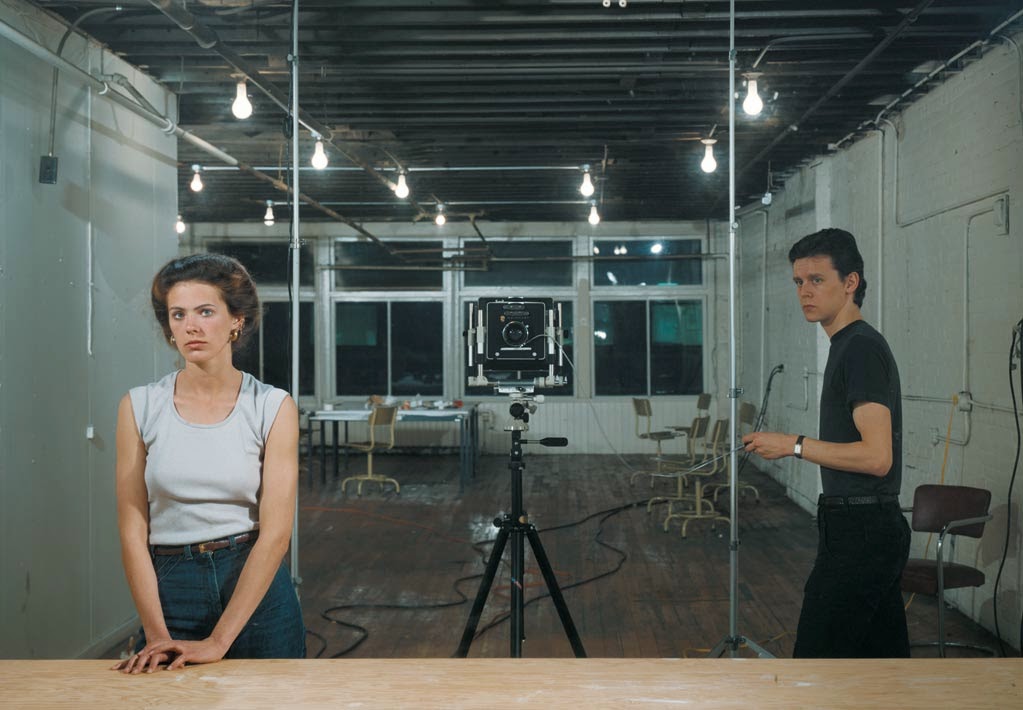
Pictures of women, by Jeff Wall
This is an optical illusion whereby the photographer trades her place with you. It is a re-photography of a camera setting.

Another interesting Postmodern photog to consider is Andreas Gurtsky. In fact we already analysed one of his extraordinary pictures.

Gurtsky's Engadine picture, with the line of skiers betraying the sanctity of the perennial snow.

Engadine. 
Gursky is also the author the most expensive photo ever sold at an auction, $ 4.3 Million, which has a mesmerizing effect, suspended as it is between the flat plane and the depth. Call it romantic! 
"Justifying this manipulation of the image, Gursky said :"Paradoxically, this view of the Rhine cannot be obtained in situ, a fictitious construction was required to provide an accurate image of a modern river."(Wikipedia)

Here it is:

Rhein II Pic (only for didactic purposes)  $ 4.3 Million!

However good and even perfectionist they are, these photogs. can't hide the fact that what they are really doing are pictures of pictures, in the second or even third degree. Possibly any passers by were cloned out of the piccie.

So where are we now? In 'Globalization' I already mentioned  that the Winterthur's Fotomuseum is currently holding a debate, where some argue that Photography is finished, because curators can't fix any criteria f for selecting Photo Artworks anymore, since anything goes. It is the End of Photography as a social endeavour in other words. 

Others have advised a return to realist, or neo-realist photography a' la Paul Strand, like Barcelona artist Jorge Ribalta:

Paul Strand's Ghana portraits. Chief and Elders

In Portraits of Modernity.

I would rather agree and that is what I try to do, by shooting simple and trying to socialize with all walks of life, with the aim of showing common circumstances. But as I mentioned in my post about Wearable Glass and 360°  I am afraid I am too late: a new technology is upon us which will sweep us into a kind of real/artificial augmented reality uneheard of before.
Perhaps we should accept the disappearance of the camera, and welcome a new degree of pictographic experience?

In fact, as Alan Kirby, Chair of Literature from Exeter Uni, UK writes we have probably entered a new phase one could call Pseudo Modernism. Beware, there is scathing in his words:

"whereas postmodernism favoured the ironic, the knowing and the playful, with their allusions to knowledge, history and ambivalence, pseudo-modernism’s typical intellectual states are ignorance, fanaticism and anxiety: Bush, Blair, Bin Laden, Le Pen and their like on one side, and the more numerous but less powerful masses on the other. Pseudo-modernism belongs to a world pervaded by the encounter between a religiously fanatical segment of the United States, a largely secular but definitionally hyper-religious Israel, and a fanatical sub-section of Muslims scattered across the planet: pseudo-modernism was not born on 11 September 2001, but postmodernism was interred in its rubble. In this context pseudo-modernism lashes fantastically sophisticated technology to the pursuit of medieval barbarism – as in the uploading of videos of beheadings onto the internet, or the use of mobile phones to film torture in prisons. Beyond this, the destiny of everyone else is to suffer the anxiety of getting hit in the cross-fire. But this fatalistic anxiety extends far beyond geopolitics, into every aspect of contemporary life; from a general fear of social breakdown and identity loss, to a deep unease about diet and health; from anguish about the destructiveness of climate change, to the effects of a new personal ineptitude and helplessness, which yield TV programmes about how to clean your house, bring up your children or remain solvent. This technologised cluelessness is utterly contemporary: the pseudo-modernist communicates constantly with the other side of the planet, yet needs to be told to eat vegetables to be healthy, a fact self-evident in the Bronze Age. He or she can direct the course of national television programmes, but does not know how to make him or herself something to eat – a characteristic fusion of the childish and the advanced, the powerful and the helpless. For varying reasons, these are people incapable of the “disbelief of Grand Narratives” which Lyotard argued typified postmodernists."

Sorry for the long text and quotations, I can strike a deal with you and promise that from now on, there won't be anymore chronologies and Art movements  involved, but only single excellent photographers brought up.

In my search for a solution of the actual catch 22 in Photography, between fake reality and unbridled fantasy,  I am considering to go back to socially concerned photographers like Paul Strand and Tina Modotti, and watch what they brought to their honest and simple table :)

No it's simply not true that anything goes, otherwise we would end up with pretentious postprocessing like this  "Ph-art" poster at DPR.

By using painterly plugins they were proud to obtain impressionist women that were done by French painters one century ago. Is this progress, mere defacing and smearing of an image, like adding too much lipstick?
David LaChapelle, Amanda as Marylin

Or take the photoshopped, beautified images of Marriage hacks that seem to have become the standard for so many camera owners.All their suburb life will be beautified, including their visits to Disneyland. And if you criticize, you ll' be called an old fart, with pretentions to something they don't care a fig about.

OverPP plus lack of visual culture have perverted the course of Photography, and created true monsters, and general mediocrity. So beauty is NOT in the eye of the beholder,  I would propose, instead it is the result of restraint, work and good intuition.

Art is very similar to Science. If you want to publish a new theory it must be Relevant to some aspect of the Physical World, and it must be Elegant, i.e. it must not waste means to get to its end. Nobody would publish sloppy Science, or a uselessly complicated theory. 

Nobody would publish some Art just because it has been made with the best camera in the World, or overprocessed with the latest software, as the majority of people believe in forums.

Instead Artists will always  do better with small but adequate means, if they have integrity, and some clear cut concepts about their work. Then it's a matter of testing these new concepts to the very end. It took Wall one year of work with actors and computers to arrive at the Gust of Wind picture! With Art you are at the forefont of the evolution of human thinking. Need any proof?

'Nihil fuit in intellectu quod non fuerit in sensu', said philosophers, from Aristotle to Berkeley.
In Art you start with the senses, but the end product is in the intellect. Photography is an intellectual endeavour, no matter how desultorily simple it appears. It is the most democratic of the arts, but this implies an even greater need for clarity, honesty and the elimination of dead ends.  Although one might be happy with the Likes and Favourites of one's Social sites, there is always a more direct, unexpected way to tap the underlying reality.

And suddenly, as a relief to these questions without answer,  it came to me out of nothing, from a sleepless summer night: just two words 'Bright Star', I was puzzled, then I remembered  it was Keats:

Bright star, would I were stedfast as thou art—
         Not in lone splendour hung aloft the night
And watching, with eternal lids apart,
         Like nature's patient, sleepless Eremite,
The moving waters at their priestlike task
         Of pure ablution round earth's human shores,
Or gazing on the new soft-fallen mask
         Of snow upon the mountains and the moors—
No—yet still stedfast, still unchangeable,
         Pillow'd upon my fair love's ripening breast,
To feel for ever its soft fall and swell,
         Awake for ever in a sweet unrest,
Still, still to hear her tender-taken breath,
And so live ever—or else swoon to death.

Appreciate the economy of means,  the  equivalence between the Star and the Beloved. It is a perfect picture, conjured from imagination. Like a perfect shot, if you wish. Likewise, there must still  be room for intuition and poetry in Photo, beyond the artifices!

Saturday, 31 May 2014

A docudrama about the short life of the photographer Francesca Woodman

This is an interesting docudrama without a title put on air at Artè TV in 2007, and directed by Jérome de Missolz,  true to Francesca's biography. It shows  well how she shot some of her best pictures. The French actress looks very similar  to Woodman, although she is a brunette, and speaks French in the film. Perhaps you can use a Skype live translator, when it comes, end of 2014

There are some factual inaccuracies, since she is using an old Exacta 6 x 6, instead of the Speed Graphic, or the Rolleiflex, she was known to use.

It is not v. probable either that she went to bed with her Italian dealer , who is here represented as an old man, while he was almost the same age of her, and provided with a jealous fiancée :)

The lesbian scene I don't know about it either, and the locations are rather abstract. Why make her a sexual maniac?  Perhaps we might make one day a better follow-up, by looking in her motivations as an artist.

The docudrama was ordered and broadcast a long time ago by a public TV, so I am told that  there is no harm in downloading it for private use. It lasts 70 minutes, and is some 250 MB, in the Mpeg4 format (Quicktime).

Be aware that when you click on the link,  the download page might be below a pop up Ads page, or in the page before that:

Or you can try a direct download here: 360p

Enjoy the movie!

The opening quotation reads: 'Je est un autre' - Rimbaud. 'I is Another'


Note

Despite  the interesting placements of the actress in front of the camera, I think that finding visual metaphors and making them into emblems,  is still a matter of hard thinking - like creating a crossword, if you wish.

I am told that the young actress was a beginner model, who enjoyed to stay on the other side of the camera. Francesca, liked both sides, but had to toil in order to achieve the right composition, since there was nobody in front of her.


And now an original F. Woodman's contact shot to compare :)


Monday, 5 May 2014

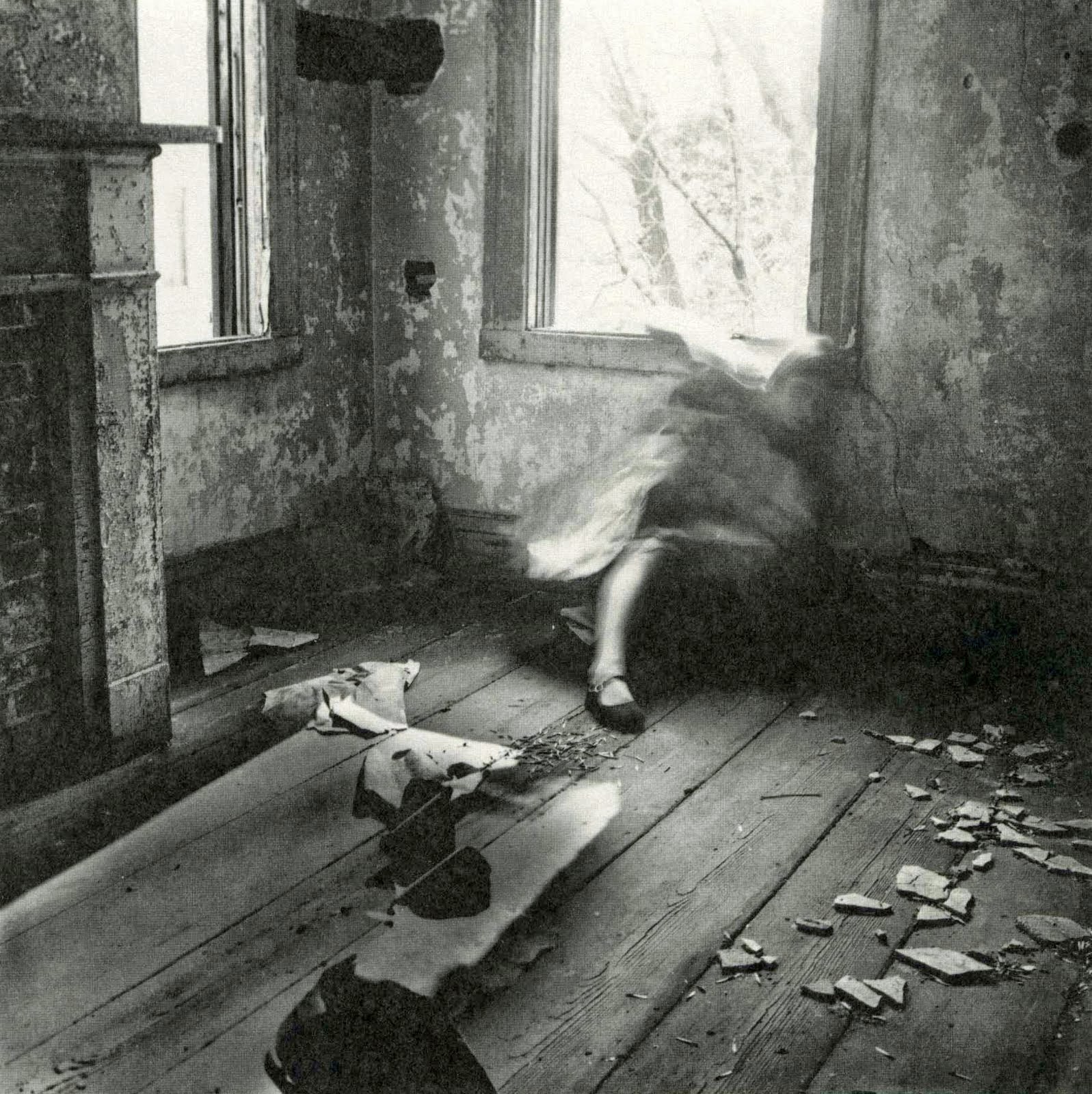
Francesca Woodman, on being an Angel


In forums, when not classified by camera model, users are presented with genres, like Landscape, Portrait, etc. That is how camera users see Photography, with documentation as the general category. We are just recording things for future memory.

Of course there is also a third way, to see it historically: Naturalism, Realism, Avant-Garde, Conceptual, Globalization. You might refine it, or adopt another sequence. Surrealism sprang out of the Avant-Garde beginning of the 1920s in Paris and had a remarkable long life, moving to America and New York in 1940 and lasting till the 1970s, with F. Woodman as one of its last heralds. 

Meanwhile Photography  had entered the MOMA in NY and had become an art.
When I began to approach critically Woodman's work, I was struck by the lack of awareness shown by the first reviews. Essentially she was dubbed a feminist, or at best a body artist, who had died in turbulent times. They had missed her seminal Italian year, when she bloomed from art pupil to full blown artist. The fact that she reached her accomplishment here in Rome at 18een, while dying at 21 in NY didn't make things easier.


It was only years later that criticism began a more refined approach. Meanwhile she had reached somehow cult status, both in the US and Italy, being dubbed the 'Rimbaud' of Photography. This put her indirectly in the Surrealist sphere, Rimbaud having been among the main inspirers of Breton and comrades. Woodman has stated explicitly her admiration of Breton's 'Nadja'.

Woodman is reported as saying "Vorrei che le parole avessero con le mie immagini lo stesso rapporto che le fotografie hanno con il testo in Nadja di André Breton" ("I would like words to have the same relationship with my images as the photographs have with the text in Nadja by André Breton").

 But among her influences there was also surrealist photogs. Duane Michals, Diane Tuberville, and the Man Ray of the Meret Oppenheim's pictures. Delving even earlier she was inspired by Gothic Fiction, Roman Baroque and Bernini's statues. Some of her studies on compressed perspective remind very much of Giotto. She might have seem him during her yearly holidays as a child near Florence. Giotto invented perspective, what luck for a future photographer to get it from the horse's mouth.

Francesca began her activity v. early at 13, spending  her time at the Rhode Island School of Design (RISD). She was also immersed in Italian art every summer by her parents, both artists, and she spent her second year of primary school in Italy, until she reached Rome with her RISD grant for 1977-78.

It's at the Libreria Maldoror, a minuscule Surrealist bookshop in the heart of Medieval Rome, where she had her first show, that I must have crossed her. Nearby the wonderful Baroque Piazza Navona   you could both find Maldoror, the occupied building of the 'femministe' (Women Liberation Front) , and the second hand shops where she chose her neorealist clothes. I remember that the slogan with those ladies was: 'Il corpo e' mio e me lo gestisco io'- the body is mine and I will Take care of it". A program that Francesca was going to adopt entirely, by being her favorite model.


She was also inspired by the Italian conceptual artists at Galleria Ferranti,  nearby Maldoror, and later Postavantgarde painters who let her use one of the large rooms in an abandoned Factory. Thus, she got in touch with Sabina Mirri (painter), Edith Schloss (poet), Giuseppe Gallo (painter) , Enrico Luzzi and Suzanne Santoro. I was acquainted with the first three, all remarkable young artists at the time.

 In the factory at S. Lorenzo she shot  her seminal 'On being an Angel' work in Rome, when just 18. A whole constellation of influences was in place, but nevertheless her work was far more original than her critics initially made it after her death in 1981, when she wasn't there anymore to correct their hits and misses about her. She could be a cultured artist and yet deceptively simple too, playing a Victorian innocent maid, a clever child the way Charles Liddel's Alice was. 

The only Art Book  she made in her short life was 'Some Disordered Interior Geometries' appeared in 1981, a few days before her death. Her parents have given access to only 700 pictures, all outstanding but her estimated production from 13 to 22 has been estimated to 10,000.  Even given for granted that a photographer must always select his/her work, we know therefore a v. little part of her work. Her work is kept by the Woodman Estate. Some 170 are being sold through galleries. The known production therefore poses a problem.

The majority of her pictures are from contact sheets of 6x6 cameras, notably an old Speed Graphic, and a Rolleiflex. The SG allows multiple formats too.

The contact shots being v. small and square confer both intimacy and a confined  space to the subject - only in her later years she planned an installation of large photographs, an installation simulating the friezes of a Greek Temple).
I related in a first post how I was sent an illustrated invitation, by her. I could make out a square with a naked body exposed to the full sunshine  from a factory window. And this reminded me later of Bernini, The Ecstasy of Santa Teresa, in Rome. Did she see it, or was it a personal rediscovery of how to tell pictorially a female orgasm?


An invitation sent to me: therefore I feel authorised to use images here for learning purposes.

Religious and sexual drives have one and the same origin  according to Bataille and other French Surrealists working towards Convulsive Beauty and a new History of Eroticism. Thus there is a common iconography across cultures. There are also common interdicts.

Without stating it so explicitly Freud posited it with its fundamental enquiry on dreams and the incest complex, when the child goes through a mirror experience because of the denial of his sexual drive, towards the mother or the  father. His Ego doubles and splits, in order  to avoid what Lacan will call 'The Thing' - the forbidden one.

The theme of mirrors and splitting is omnipresent in Francesca.
Hysteria was also part of the constellation, and was the main study at the Salpétrière hospital where Breton had been a nurse: were transe, orgasm, and religious ecstasy one and the same thing? Breton took an interest, because he believed that the sublimation of the sexual drive would have made art revolutionary: 'la Beaute' sera convulsive ou ne sera pas'.

By visiting each Summer Florence and her public Renaissance Gallerie, Uffizi and Pitti, Francesca must have been well aware that an excess of light was akin to the visitation of an Angel, and the total awareness of the artist, visited by inspiration. Nakedness in the Renaissance was also a metaphor of truth.

As Dr. Eva Rus remarks in her paper, the theme of the mirror is indeed omnipresent both in the work of F Woodman and other Female Liberation's authors. It is a theme that both frees the body and protects it with mirrored, multiple identities. It can also encage however.

In Feminist parlance, by exposing her naked body to a mirror, she re-appropriates it. She echoes male desire, but she also detaches herself from it.
Both David Bate and Eva Rus have discussed the implications of this important theme. It is a counter to the paradox that Breton and he early  Surrealists  had come against with their theories about Woman and sexuality, both a Goddess and a public woman, with Sadism and Courteous Love taken in the same stride.
Rus mentions that by her work,  Francesca was speaking for women, not just for a woman, playing with male desire, but not ending in it, exploring instead womens' sexuality, and identity down to the unspeakable, and the excessive (Rus). 


One's own shadow, duplication, wish to disappear, and condensation of dream figures are all part of the Surrealist imaginary, suggested by Freud. You can all find them in Francesca's figures. She played with the whole range of the Freudian symptoms to reenact myths. So we go from the passive interpretation of the unconscious drive by the early surrealists a' la Nadja, to active impersonation of dream figures by Francesca - the mark of genius! 
In some pictures one wonders if turning rapidly about herself she didn't achieve a trance like a dervish, and disappearance into space - blending the frame and the object in another dimension.

Despite the excess, let me remind that Francesca has aptly described her work as solving visual ideas as if they were equations 

 "I had this idea to illustrate physically literary metaphors  and to make physical metaphors for moral ideas (the reputation). However by working slowly at other projects, I lost the peculiarity of this idea and I came out with a group of images that didn't illustrate any specific concept, but are the story of someone who is exploring an idea […] Let's  follow a figure who tries to solve the idea as if it were a mathematic problem, and to fit it inside an equation. Two months later […] I was back to the original theory for illustrating 'Self-deceit' […] the thing that I found most interesting was the feeling that the figure, more than hiding from itself, was absorbed by a thick and humid atmosphere".

Do you understand the description? Visual artists are often deceptively simple, but they cannot explain what they choose to illustrate in another way.  This is how I basically see her work, since at the time I was a performer myself. First you empty the scene, the physical space around you and in your mind. Then you begin testing visual hypotheses in this virtual space. You use chance associations, even dreams  to suggest the solution, how things must fit spatially.
In Self-Deceit the object of the camera, the model, literally navigates between two mirrors, the second being the camera, and in  this virtual space it becomes again a subject - with multiple directions and identities it can choose from.

The camera however is not only a mirror but a a perspective machine.  For Francesca thus the problem, as for every photog, must have been to fit a 3D space in the bidimensional plane, and in her medium format a  6x6 square at that. 
In some shots her caged body  acts to as the bridge between the illusory three dimensions of the perspective and the plane of the photo. Often the frame beheads her, as in the first picture, and here:


It immediately reminded me of the problem faced by Francis Bacon, when fitting a soft blob of a body, a monster inside a perspective cube, drawn with sharp lines, cutting as blades.

Francesca could do the same by fitting a mirror at the end of the frame and by moving rapidly in front of the objective with slow shutter speeds.  "Me and Francis Bacon and all those Baroques are all concerned with making something soft wiggle and snake around a hard architectural outline." So I wasn't wrong after all.


Again, did she use the rapid movement just to disappear, or to achieve some sort of transference through the looking glass, like Alice?

Let me end here with one of her most interesting pictures, where she transforms herself like Daphne  into  a tree, in a pond in Providence, USA. You can easily compare it to Bernini's work, which Francesca must have seen while in Rome.


In symbolic terms the scene is interpreted as the nymph transforming herself into a tree, to flee a rape by Apollo. It might also be interpreted as another metaphor of desire imagined by Bernini, where woman becomes again unconstricted nature, to escape male desire. Is that what Francesca had in mind with her Providence surprising picture? Or did she want to be"absorbed by a thick and humid atmosphere" and disappear in a protective womb?

Besides the psychological interpretation, as photogs. we might wonder how Woodman solved the technical problems. Where did she place her Speedgraphic, in the water, on a tripod? Did she frame exactly the roots under which she would then have placed her naked body like Daphne? Did she use flash lights? What a fascinating way to work, for a girl who was just 18, and yet already so mature.

So we know a few things now about Francesca's very original  approach to photo work, but in the next instalment I would like to explore better her symbolic world with Dr. Eva Rus from the U. of Birmingham. I found it to be a most fitting paper about Woodman,  after I read so many mundane comments that missed the artist, and only described the woman.

Francesca went so deep in her photographic performances and metaphors that it is difficult to imagine anyone as her successor - although she has many imitators.  Perhaps that explains too her cryptic statement before she took her life. She was really an angel who departed before people took notice of her, except a few fellow-artists.

"I have parameters and my life at this point is similar to the sediments of an old cup of coffee, and I would rather die young, preserving what has been done, instead of confusedly rubbing out all these delicate things,

She threw herself from a skyscraper in NY,  after a long depression, insufficiently cured by analysis, allegedly because of a grant application having been rejected.  

Others mentioned she had wanted to become a Fashion Photographer, like her admired Tuberville. Perhaps Vogue rejected her? -  an issue complicated by problems with her boyfriend.

My next enquiry would rather be if in her 'descente aux enfers', descent into hell, she had not rather reached something monstrous, a figure of the unconscious which was unbearable, like those wrathful deities that Tibetan Buddhism tries to exorcise and exalt at the same time. This was the monster in 'Yet another leaden sky':


  Francesca could use elegant metaphors, like the momentous arrival of a turtle in a room. Her double hides from it, and  is literally cornered by the monster in a shortened perspective, and as a result it loses its face. It wears the black veils of melancoly. It is an emblem that needs to be decoded, and yet keeps a high degree of ambiguity.

Notes:

1. I have avoided nudity, which is difficult with F. Woodman, to respect the guidelines set by my tentative sponsors, Amazon and Google. On another plane, belonging to the same generation of Francesca, we can both have a (sad) laugh at it. By a paradox you can see all the pictures of her lovely body, by doing a Google search :)

2. I propose you to solve an enigma. Because of her short life, and because she worked with film (120 format mostly) I cannot be sure if we see now her actual prints, or negatives that were printed by the Woodman Estate. This would also tell us how much she postprocessed in a film darkroom.
My impression is that she did just contact sheets, and solved all the problems before pushing the shutter button. That is, she used slow shutter and double exposure to achieve her disappearing acts. The S. Lorenzo lofts with big industrial windows would have offered all the natural light she needed.
Keep in mind that I have somewhat enlarged the original 6x6 size to better analyze the details. In the 'Daphne' shot, the contour  of the tree seems to have been relighted, since it has a kind of otherwordly glow. Relighting however was standard processing in film times.

3. The bare facts of her life by Wikipedia

Sunday, 20 April 2014

'Nadja', a follow up.

* Warning: Intellectual stuff! - jump altogether if you are not into psychology and deconstruction.

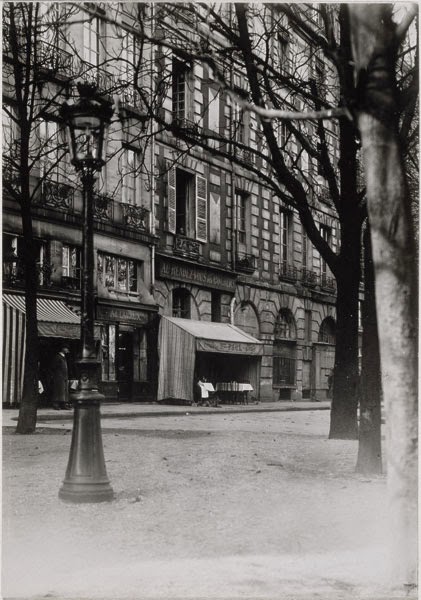
My friend Daniel Jouanisson, videographer, sent me this photo update on the squares of Paris in 'Nadja'. Judge yourself how little they have changed in almost one century!

Hotel des Grands Hommes
How important were those squares for the  the story of Nadja? Here is another interpretation by Critic David Bate, from Westminster University in 'Photography and Surrealism' .

Deconstruction technique is interesting here because it allows to get to the bottom of the most indifferent image, and extract its true meanings. Remember: no photograph is innocent!

You can always connect it to a context, to a choice and a photographer's point of view. Here we are told about Nadja's madness, so pychanalysis is suitable, and it might even explain the hidden meaning of those sad squares that populate the book.

In his book, Bate relates Surrealism and Sexuality, giving an explanation to the Enigmatic.

Some images draw us, even if we don't know why. Interpretation can provide the explanation. Finding the culprit is like finding a serial killer by Forensic Science. 
Out of necessity the language is specialized. My comments will try to clarify.

David Bate: "The photographs in 'Nadja' echo this structure of loss through their emptiness. As the reader views the photographs in relation to the text, the pictures are dis turbingly empty, 'lacking' in actual events. Looking into these photographic spaces where any decisive momenthas 'disappeared', we wonder what is the other there. 
Just as Nadja loses her image of identification, so the 
reader of Nadja is deprived of a reflected identification 
in the photographs. Most of the photographs, even the 
portraits, have a mute and mournful look, there is a 
'dinginess' in these pictures, rarely noted by commenta- 
tors as such, through which their 'mood' of emptiness 
invades the book. 
Expecting to find photographs of the events in their captions, the reader finds them lacking and it is in this way that an enigma emerges".

In the book the onset of the Enigma is also marked by the impromptu appearance of a fortune teller:


When Nadja told Breton she saw herself as Helene, Breton was reminded that a clairvoyant had predicted days before their meeting that he would get involved with a Helene. Another unlikely coincidence!
Breton and Nadja are approaching the Unconscious zone, which is timeless. They can meet, but they can also differ, having different unconscious goals.

David Bate: "Towards the end of Nadja, Breton says that he wanted some of the photographic images of the places and people to be taken 'at the special angle from which I 
myself had looked at them'. This proved impossible; 
the places 'resisted' this and thus, for Breton, 'as I see 
it, with some exceptions the illustrated parts of Nadja 
are inadequate'

"Breton mythologizes these places, as having some- 
thing in them which resists representation. This only 
makes those places gain in enigma. There is little or no 
attempt to show things as literally from Breton's point- 
of-view in the photographs. In the photograph of Place 
Dauphine, the view is outside, looking in. One would 
have to be a disembodied voyeur to be able to 'see' what 
cannot be seen in these photographs. Whatever Breton 
says himself in the book, the photographs make crucial 
contributions and their presence gives a distinct feeling 
to the book. Can it be that this is what Breton meant 
when he described the photograph as 'permeated with 
an emotive value'?"


                    The uncanny Place Dauphine, where Breton and Nadja were to have dinner.

What is not said is that most of those somber Paris' squares in fact have been the theatre of acts of blood. In Place Dauphine was executed Jaques de Molay, the Master of the Knights Templar. Nadja perceives it and exclaims: "Et les Morts, les morts!" - she can feel the dead, she registers them. She predicts a black window turning red, and a few instants later a window lights up showing bloody red curtains! 
Another of those squares they meet at is where Marie Antoinette was beheaded. Those are not innocent places. They carry the mark of the public execution of a paternal figure.

"'Sadness', says Julia Kristeva,'is the fundamental mood 
of depression.' Certainly the photographs in Nadja are 
not joyous, they resonate with solitude. The ghosts of 
'whom I haunt' appear through their absence; as in the 
solitude of the child at the primal scene, with the parents 
'away' enjoying themselves. In this paradoxical signifying 
structure the signs are empty but never 'empty', they 
still signify. The enigmatic message of emptiness draws 
us back to those feelings and affects in the story of 
Nadja, where madness and sanity are combined in 
the mood of melancholy sadness. This mood is based 
on an identification with the lost object, where the 
depressing and depressed feelings hide an aggression 
against that object." [The Father Figure, she identifies Breton with]

"Nadja is a story in which Breton nevertheless undoes 
himself a little. He is clearly haunted by Nadja's 'madness' 
and the experience of their encounter — even if, as a 
trained psychiatric nurse, he can still say: 'You are not 
an enigma for me.'

"Meanwhile, the eyes of Nadja,repeated insistently
 in Man Ray's montage of them in Nadja,
 place Breton and the reader under her surveillance 
(an image added by the author in 1964)."


"The book ends famously with the seemingly im- 
promptu and rushed conclusion: 'Beauty will be CON- 
VULSIVE or will not be.'The 'beauty' here for Breton is 
the hysteric in convulsion, but in the end, Breton remains 
on this side of the symbolic order, he is the neurotic 
witness to his own unconscious conflicts, while Nadja 
is given to signify the unconscious and can no longer 
bear witness to her own thoughts. 

"Nadja transgresses the symbolic order and pays the price of incarceration. As Simone de Beauvoir wryly notes: 'She is so wonderfully liberated from regard for appearances that she scorns reason and the laws: she winds up in an asylum.'"

"The paths of the sexual question 'Who am I?' are 
different for the man and the woman in 'Nadja'. The 
different trajectories relate to the different relations to a 
paternal image. If beauty is hysteria, it is in the opening 
up of an identification with the other. In patriarchal 
law, as Lacan points out, the question of 'woman' is of 
an 'identification with the paternal object' through the 
Oedipus complex. It is surely this relation that Breton 
explores in Nadja and is perhaps why the photographs he 
chooses are so emptied of such potential identifications, 
except one photograph: of himself. "


To Nadja the acts of blood make the squares terrifying, the very image of parricide, while for Breton,  they are just depressing, reminding him of his literary forebears. 

"The 'whom do I haunt?' posed by Breton at the beginning of the book is revealed as Breton's melancholic 
trawl of the patchwork of paternal literary figures 
(Rousseau, Nerval, Baudelaire etc.) emerging in Nadja
as the 'primordial' signifiers that make up his Paris.  
Breton buries himself in relations to these signifiers as 
he delves into a bit of Nadja's psychosis. His fleeting 
interest in Nadja is as link to that lost literary history"


See how the same image can bring about different responses? A realist interpretation would never have explained them. Surrealism brings to the images the powerful contribution of the unconscious. Internal feeling is as real as the material reality out there.
'Nadja' is very important for the History of Photography, because it introduces the concept of shifting signifiers - there's not a one-to-one correspondance with what the image apparently depicts.
Realism, the earlier paradigm of photography, is therefore inadequate.

Although Breton died in 1966, Surrealism continued to exercise its influence up to the 1970s, notably in the work of women photographers, such as Diane Arbus, Cindy Sherman, Francesca Woodman - who mentions explicitly 'Nadja' among her  influences. 
 With her performances and body art photographs Francesca Woodman  showed  how women can reappropriate their own bodies, by turning upside down the male imaginary.

                                             *
And now, just to lighten up, another photo from my friend Jouanisson on American Realism:


No Photo is innocent! We will soon discuss what happened to photography at the era of the internet globalization. When everything went to the dogs with a surfeit of special effects, allowed by the advent of digital. And when millions of digital images pushed aside what had been the little world of the paper image.
Stay tuned!